
Second World War bombs to remain buried in Route Isabelle field
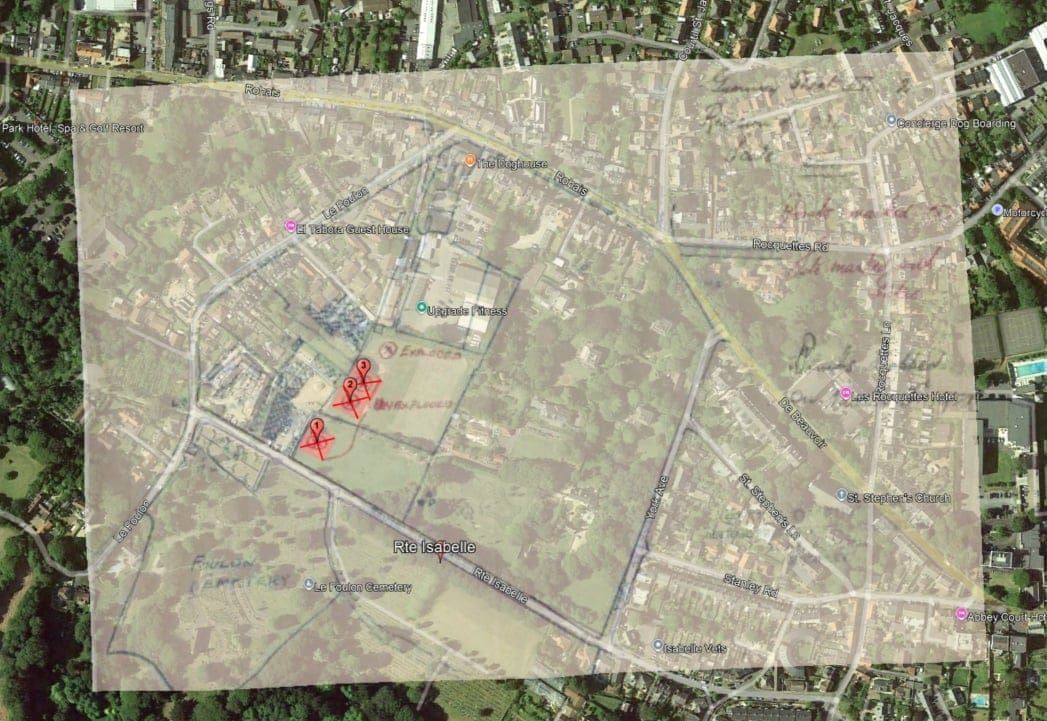
- Four 2,000lb British bombs from Second World War to remain buried eight metres underground in Route Isabelle field
- Expert analysis concludes bombs unlikely to be armed and pose no threat to life
- Campaigner argues they should be dealt with and questions past actions by politicians and senior civil servants
- Bombs believed dropped from British Short Stirling Bomber after aborted raid on German naval vessel
- Decision made following extensive consultation with Ministry of Defence, NATO specialists and British Army experts
Key terms
Four British air-dropped bombs from the Second World War will be left buried eight metres underground in a field in the Route Isabelle and Le Foulon area.
Home Affairs has agreed to leave the ordnance in situ after it said detailed analysis concluded that disturbing the weapons would present greater risks than leaving them undisturbed.
They were prompted to look for the bombs after a sustained campaign by bomb disposal expert Ben Remfrey for a thorough investigation, having initially in 2019 only gone four metres deep.
Deputy Marc Leadbeater, Home Affairs President, said: "We want to reassure the community that this decision has been taken following careful consideration and has been guided by extensive expert evidence and a clear understanding of the very low level of risk involved.
"The expert analysis shows these devices are highly unlikely to be armed and leaving them undisturbed at depth is the option that presents the least risk to the community.
"Our priority throughout has been public safety and this decision reflects the best technical advice available which shows disturbing them would create far greater risk."
Mr Remfrey said: "When, in 2019, I began this campaign to prove these devices were in place adjacent to Route Isabelle, the then Home Affairs Committee denied the bombs even existed at all and claimed I was spreading ‘old wives’ tales’ and that I was a troublemaker.
"Now, after my efforts I hope these same people accept the bombs are there and mistakes were made. I take some pride in the fact that all reports assess that these bombs are of the type and from the very aircraft my research indicated.
"I feel fully vindicated in my efforts to bring these devices to the public’s attention; my concern was always for the wellbeing of the residents and the landowners. This land having been handed on through five owners since the 3rd March 1941, none of those people buying the land were ever informed of the bombs being in place on the land, which the local authorities knew full well."
The nearby Wellington Clos should never have been built, he argued.
"There is no fault or negligence by the Emergency planning team from Home Affairs Department, they have stuck to their task of ensuring due process was carried out in the best interest of the local population.
"I cannot say the same for those in political office and senior civil servants in the past who knew fully well that developing the site, despite records suggesting there was live ordnance close by remains in my view utterly negligent and wrong."
He remains convinced the bombs should be dealt with and "rendered safe once and for all".
The four tail-fuze armour piercing bombs, each weighing 2,000lb, were confirmed to be buried at the site following a survey carried out last year.
Historical records have now shown that the bombs were dropped from a British Short Stirling Bomber after an aborted raid on a German naval vessel near the coast of France. It is believed they were dropped by the crew to empty the aircraft after the raid was called off.
The decision to leave the ordnance in place was based on two key findings highlighted in MoD reports. Firstly, experts believe it is unlikely the bombs were armed before they were dropped, either because the safety features of the fuze were not removed or because the bombs were dropped from a height insufficient to arm them. The fact that none of the four detonated also reinforces this conclusion, Home Affairs said.
Secondly, while some fuzes contain celluloid disks which can become brittle over time and therefore present a hazard even if unarmed, these particular bombs do not have celluloid disks and utilise a percussion firing mechanism instead, they said. As a result, disturbance of these bombs should not cause them to detonate, nor would degradation over time.
Home Affairs commissioned a survey last year to establish the depth and exact locations of the air-dropped weapons. The findings and recommendations from this survey, along with a separate report from the Explosive Ordnance Disposal Technical Information Centre – a NATO specialist asset – led to a risk analysis being commissioned from the Defence Science and Technology Laboratory, a specialist branch of the MoD.
The EODTIC report concluded that the four bombs were high explosive aircraft 2000lb armoured piercing devices fitted with fuze percussion aircraft bomb tail number 37. Evidence supports that the bomb fuzes are unlikely to be armed, and the bombs and their fuzing system are highly unlikely to spontaneously detonate. One of the bombs is believed to have suffered dynamic breakup through impact.
The DSTL report analysed the potential impact of a spontaneous detonation if one were to occur.
It concluded that the likelihood of one bomb detonating triggering another to explode was remote, between 0% and 5%.
The probability of damage to local infrastructure from a detonation of a single bomb was assessed as highly unlikely for major damage, described as serious cracking of plaster or dry wall and fall of material.
Minor damage, described as new fine cracks in plaster or dry wall joints or the opening of old cracks, was deemed unlikely. No damage or cosmetic damage was considered a realistic possibility. No threat to life was identified. The report noted that these risks would be heightened if the bombs were excavated and then spontaneously detonated.
All of this work was carried out and analysed in liaison with experts from 11 EOD & Search Regiment from the British Army and the island's Joint Regional Liaison Officer from the MoD.
Other options considered included excavating the bombs and then transporting them to the beach, floating them out to sea, and detonating them offshore.
However, a very large evacuation cordon would have been required around the site while this excavation was carried out, likely up to 1.5km, and this could have been needed for a number of days.
The cordon would have then had to follow the transports moving the ordnance while it was relocated. The British Army would not have supported excavating the ordnance and detonating it in situ.
The Committee met with residents and the owners of the field on 6 May to talk them through the decision alongside a representative from 11 EOD regiment.
Kevin Murphy, Channel Islands Emergency Planning Officer, said: "Our planning has been guided at every stage by specialist advice from the Ministry of Defence, the British Army and a NATO specialist asset.
"The assessments show that the ordnance poses no threat to life and only a very small chance of any structural damage if they do detonate, and the chances of that happening are extremely small.
"By keeping the bombs safely buried, we avoid the significant disruption and unnecessary increased risk that excavation would create. I'd also like to reassure the community that this decision is not the complete end of the matter. We will continue to monitor the situation and if any changes occur, reassess the best way to achieve public safety."
In a statement, a spokesperson for the Ministry of Defence said: "The MoD has provided support and advice to the States of Guernsey throughout this operation. Our aim has been to enable to the SoG to make informed decisions and ensure public safety. The MoD has, and will continue to supply, timely expertise and scientific information on request."
Background and history
On the night of 3 March 1941, four bombs were dropped on land near Route Isabelle, some on Lihou's Farm. Letter correspondence between authorities in 1941 indicated two bombs left funnels, with one suspected to be 26ft deep, and the Germans used explosive charges to close up the holes. Lieutenant Voegeli, an unqualified German officer in charge at the time, stated the bombs would not pose a danger of exploding in future. Police became aware of the potential issue in a privately owned field in 2018. In 2019, the States commissioned a UK company to undertake a survey to ascertain the exact location of the bombs, but the survey was done with limited resources and only probed about 4 metres deep. The 2019 survey found no evidence of any anomalies. Wellington Close received planning permission in February 2019, with no mention of the possibility of bombs. In October 2024, bomb disposal expert Ben Remfrey decided to go public with his claims following the unexpected explosion of a Second World War bomb at a Japanese airport. On 29 October 2024, a constructive meeting took place between the States and Remfrey regarding unexploded Second World War ordnances which historical documents indicate are buried in the field. In February 2025, authorities announced a deep survey would take place to identify whether three unexploded bombs are buried under fields along Route Isabelle. By May 2025, 6 Alpha Associates was appointed to conduct the deep survey. In June 2025, the survey located three anomalies, which initial assessment suggested could be unexploded ordnance.
Q&A
Q: Why are the bombs being left in the ground?
A: Expert analysis from the Ministry of Defence concluded that the bombs are highly unlikely to be armed and leaving them undisturbed at eight metres depth presents the least risk to the community. Excavating them would create far greater danger.
Q: Do the bombs pose a threat to local residents?
A: No. The expert assessments show that the ordnance poses no threat to life and only a very small chance of any structural damage if they were to detonate, which is extremely unlikely to happen.
Q: How were the bombs discovered and what happens next?
A: The bombs were confirmed to be at the site following a survey carried out last year. Authorities will continue to monitor the situation and reassess if any changes occur.

Comments ()