
Guernsey Arts Sunday Live: the £10m. vision for a Victor Hugo Centre to open in 2029
- A £10 million Victor Hugo Centre is planned to open in Guernsey in 2029, located in the former Tourist Information building in St Peter Port
- Fundraising has reached £7.5 million so far, including £2.5 million in match funding from the States of Guernsey
- The three-floor centre will feature performance and exhibition spaces, a museum with seven galleries, and a learning centre focused on Hugo's values of human rights and social justice
- Victor Hugo wrote Les Misérables in Guernsey after arriving in 1855, though few of the musical's million-plus global audience know of the island connection
- Planning application expected before year-end, with construction beginning in late 2025 for a two-year build period
Victor Hugo arrived in Guernsey in 1855 having not published anything of great significance for more than a decade.
Within a year that had changed, and what followed included Les Misérables and Toilers of the Sea.
The island was an inspiration.
A catalyst for creativity and artistry.
For 18 months fundraising has been happening for a £10m. Victor Hugo Centre, which will be located in the former Tourist Information building at the heart of St Peter Port.
It will complement what is already on offer at Hauteville House, which Hugo bought soon after arriving in the island, by creating exhibition and teaching spaces.
There was perhaps some skepticism that the money would be forthcoming, but so far those behind the vision have raised £7.5m. (the States has agreed to match fund up to £2.5m. as part of that).
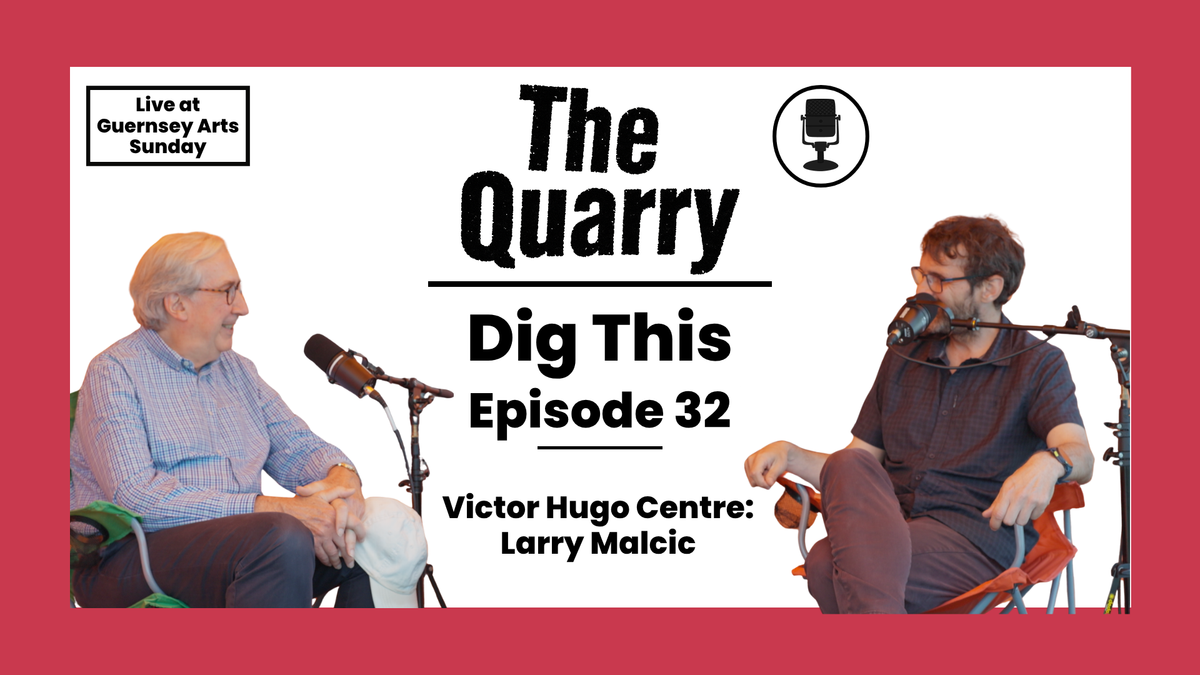
“I think that people recognise that what we're doing is bringing value in many different ways to the island, because we have, of course, the cultural benefits, but also educational heritage, tourism, and economic benefits that will flow from the center,” said Victor Hugo Centre chair Larry Malcic in conversation with The Quarry live at Guernsey Arts Sunday.
“The center really is made up of three parts.
“We have on the ground floor a performance event and temporary exhibition space.
"On the first floor, the museum to Hugo, with seven galleries, starting, importantly, with Hugo's Island, the story of Hugo and his rapport with Guernsey, and then the top floor is a learning center for school children and students, using Hugo really not just to tell them about a historic figure from the 19th century, but rather as a way for them to unlock their own imagination, creativity, and social awareness, because Hugo was a great proponent of human rights, social justice, universal education, freedom of expression.
“These are fundamental Enlightenment values that today, generations later, are actually under threat in many parts of the world, and we believe that Guernsey should be adding its voice to support those key ideals.”
The launch of the campaign has given everyone the ability to talk about Hugo as a global icon.
“He is a figure known throughout the world, and if you think even just of Les Miserables, the musical version of his work that has been produced in 45 countries [and performed] to over a million people, and very few of those people sadly know that this is the home of Les Miserables, that he largely revised, rewrote, and published it from Guernsey.
“We want that message to go to the world, so that it will help Guernsey in terms of its cultural diplomacy.”
Malcic is unapologetic about how ambitious the project is.
“In London I was the architect for the Churchill Museum and Cabinet War Rooms, the Darwin Center at the Natural History Museum, the Enlightenment Gallery at the British Museum, and there's no reason why Guernsey shouldn't have a museum that is equal in quality to any of those.”
There is already a growing influx of visitors from France thanks to the Brittany Ferries link, but limited space at Hauteville House, which is also open for only six months a year, means there is an opportunity.
The cruise passenger visitors are another target.
“Having the location in the former visitor information center, right on the seafront, exactly where the ferries and the cruise ships come in, mean that it will become a fantastic gateway attraction for Guernsey.”
Hugo kept meticulous diaries of everything he did in Guernsey, and his story has also become a way of exploring the island.
There are now trails in town and on the cliffs so people can follow in his footsteps. Information boards have links to audio of his poetry or prose in French or English. Next month a visiting expert, Dr Bradley Stevens, will talk about Hugo’s views on war and peace.
Conversations are continuing to raise enough money to achieve longer term financial independence.
A planning application is about to be submitted with the aim of getting approval before the end of this year.
Building work would then begin in the second part of next year with a two year construction period so the centre can be open for the main summer season in 2029.
Background and history
Victor Hugo's connection to Guernsey began in 1851 when Louis-Napoleon Bonaparte staged a coup d'état in France, proclaiming himself Emperor Napoleon III and abolishing democratic government. Hugo, who had been elected to the National Assembly and became increasingly vocal on issues including press freedom and the death penalty, openly labelled the new emperor a traitor to France. With his arrest ordered, Hugo fled first to Brussels, then to Jersey in 1852, where he stayed for three years. In 1855, after supporting fellow exiles who had published satirical articles about Queen Victoria's visit to Paris, Hugo was expelled from Jersey and arrived in Guernsey in October that year. In May 1856, he purchased Hauteville House using proceeds from his poetry collection Les Contemplations, strategically securing property ownership to prevent deportation under Guernsey law. Though Napoleon III offered amnesty in 1859, Hugo refused, seeing acceptance as a betrayal of his principles. Over his fifteen years in Guernsey until 1870, he completed Les Misérables and wrote Toilers of the Sea, which he dedicated to the island. In 1927, Hugo's descendants donated Hauteville House to the City of Paris, and it opened as a museum.
Q&A
Q: How much money has been raised so far for the Victor Hugo Centre?
A: £7.5 million has been raised so far toward the £10 million goal, including £2.5 million in match funding from the States of Guernsey.
Q: What will the three floors of the Victor Hugo Centre contain?
A: The ground floor will house performance, event, and temporary exhibition spaces. The first floor will feature a museum with seven galleries about Hugo, starting with 'Hugo's Island' about his relationship with Guernsey. The top floor will be a learning centre for students focusing on Hugo's values of human rights, social justice, and freedom of expression.
Q: When is the Victor Hugo Centre expected to open?
A: The centre is planned to open in 2029 for the main summer season, following a planning application submission expected before the end of 2024 and a two-year construction period beginning in late 2025.

Comments ()