
AI transforms Guernsey's creative industries but human expertise remains irreplaceable, panel finds
- AI is delivering dramatic time savings across Guernsey's creative industries
- Panel concludes human creativity, storytelling and expertise will become more valuable as AI-generated content floods the market with mediocre work
- Creatives urged to think about keeping control of what they enjoy and not outsourcing those to AI
- Questions about intellectual property as platforms require designers to surrender design rights and copied work spreads globally
- The Quarry outlines how AI buys it time for the crucial human side of journalism
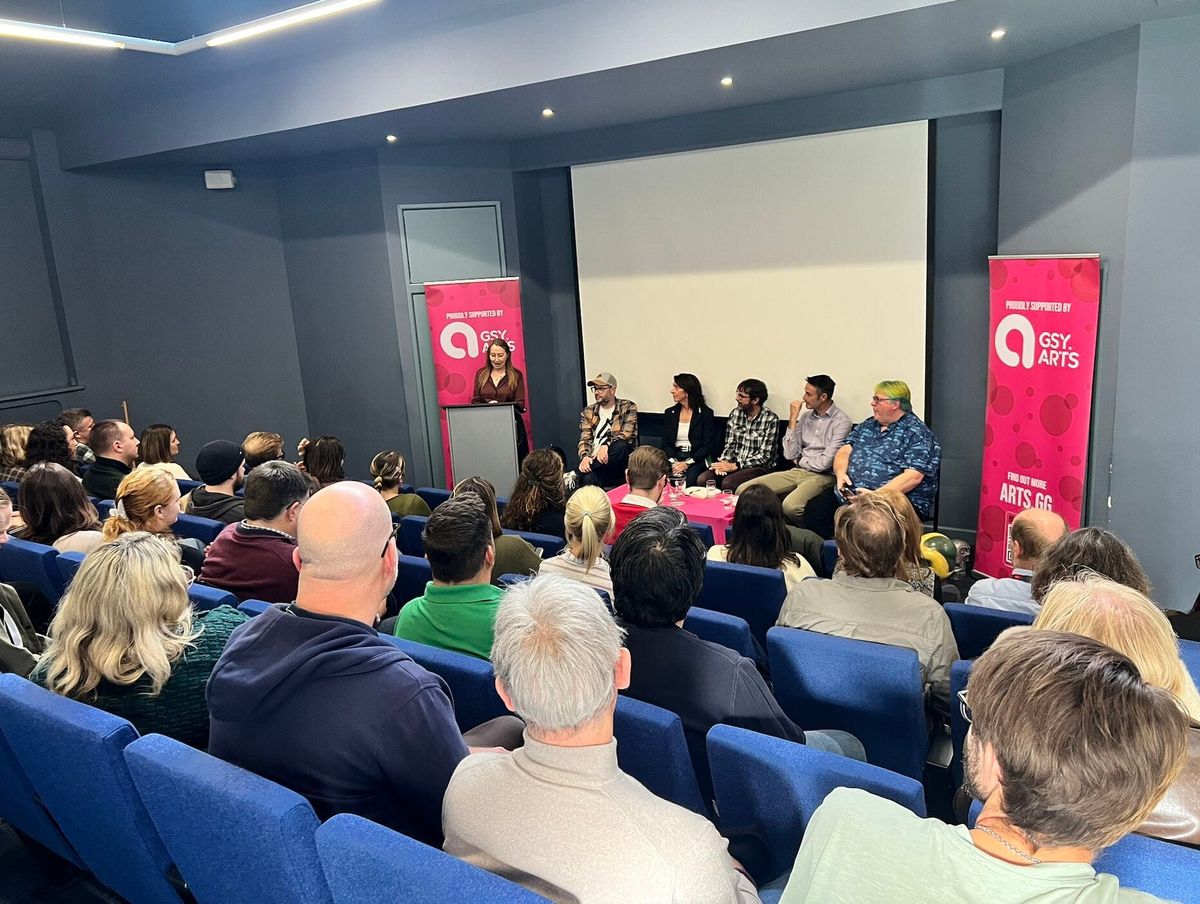
Artificial intelligence is fundamentally reshaping creative work in Guernsey, with dramatic time savings across design, fashion, filmmaking and journalism, but human creativity and storytelling remain essential competitive advantages, a panel discussion during the AI Sprint has revealed.
The Guernsey Arts event brought together creative industry experts who detailed how AI has revolutionised their workflows, whilst McKinsey research predicts 45% of jobs may be automated over the next two decades.
Tom Langford from The Potting Shed outlined a significant shift in how AI impacts the creative process, divided between ideas and execution.
"I think with the ideas, it hasn't changed things a huge amount," Langford explained. "There's obviously more we can explore more quickly, check if ideas might work, but really it's the execution side of things that has changed quite dramatically."
A campaign created six months ago used AI-generated images instead of stock photography, creating bespoke images with consistent tone that appeared like "a 500 grand photo shoot" without the corresponding budget. Voiceover work that previously took over a week can now be completed in less than a day using over 200 AI voices in different accents.
Kay Davidson, an independent clothing designer who described herself as "very old school," revealed AI has transformed technical processes. Drawing a garment specification traditionally took three to four hours, but with AI assistance, the same tech pack can now be generated in three to four minutes — an approximate 98% time saving.
Davidson still sketches by hand with pencil and paper, saying "AI can't take that from me." Hand-drawn sketches are scanned and converted to flat lays, then tech packs. Customer changes that previously required hours of work now take minutes through text prompts.
She noted that AI's usefulness for tailoring has only become viable in the last three months, as earlier versions were "just so skewed." For tailoring work, "the displacement of a seam, even by a couple of centimeters, will completely throw the balance of the jacket off."
Davidson highlighted significant carbon footprint reductions through eliminating prototype sample rounds. Traditionally, sample packs would travel to three or four different factories worldwide for initial samples, returning for second, third, and sometimes fourth iterations. With AI-generated tech packs, many garments can go "straight to sealed samples," eliminating physical movement of goods.
She also pointed to virtual try-on technology implemented by Zara, using phone-scanned body metrics to suggest best fit, potentially reducing returns that often end up in landfill.
However, Davidson raised concerns about entry-level AI platforms that allow anyone to design garments through text prompts, which often require designers to give up design rights. "You've lost the ownership of it by using these... that platform owns your design," she said, adding these platforms encourage volume production of "fashion that nobody really needs."
Charlie Towers, a lecturer at Guernsey Institute and prop designer with 26 years of experience, provided dramatic examples of AI's impact. A scheme of work that traditionally took five hours can now be completed in five minutes, saving approximately two hours per day in teaching-related tasks.
Their awarding body, University Arts London, has fundamentally changed assessment. "They don't want to see essays anymore. There's no point. They're going to assume an essay is AI generated," Towers said. UAL now focuses on practical work and allows AI-generated initial designs if students "take it further." The institution specifically banned Canva use for portfolios this year.
Towers demonstrated his evolution from traditional sculpture to AI-assisted creation. For a Johnny Alpha commission, traditional digital sculpting of a helmet took approximately two days, whilst an AI-generated character body took approximately 20 minutes. The previous method would have taken "a couple of weeks."
For a Marvel commission, Towers created a medallion for Doctor Doom in an upcoming film. The digital model was sent to a colleague in Georgia, USA, who forwarded it to Pinewood Studios for printing, metal casting, and finishing.
"I felt it works okay because the same skills I'll apply to this for painting it and actually finishing it and completing it," Towers said.
He described a fashion student who initially refused to use AI, saying "I'm never going to use it. Keep it away from me," but is now creating a kinetic carousel dress using AI-generated carousel imagery for decorations. Engineering solutions still require human expertise because "AI suggested some things that I had to tell it that won't work."
Warren Mauger from Spike Productions identified "collateral damage at all levels" in the film industry. Voiceover artists are "losing their jobs, hand over fist," camera operators are being replaced by AI-tracking cameras in sports and events, and editors face significant changes to their craft.
Mauger revealed that actors are being offered "quite big sums of money to clone themselves" — between £20,000 and £30,000 for one day in a studio to be mapped. After cloning, these actors appear in Instagram posts and TV advertisements. "You basically have sold your image right," he said, warning of potential career damage: "You could be appearing in things you really don't want to be appearing in."
Within the last few weeks, integration with edit suites via Claude and other platforms allows text-prompt editing. A project that would have taken "a day and a half" was completed in 15 minutes.
However, Mauger emphasised a critical caveat: "I knew what to prompt, and I think you have to have a vision for this in the first place as a human. You have to have the idea, and you have to know how to execute it."
He compared AI efficiency to an artist painting for one hour and selling for £1 million: "I've been doing this for 60 years. I know what I'm doing... The value is in the output, not necessarily in the time span."
Nick Mann from The Quarry described AI as enabling his business to exist at all. "As a business, we actually exist because I can do the work of 3, 4, 5 people now, which I couldn't before. You just could not imagine that a couple of years ago," Mann said.
AI provides intelligence gathering each morning, sweeping around to find what's happening in Guernsey and around the world, enriching stories to make content "more engaging and more interesting," and enabling website building without relying on traditional technical teams.
"If we get all the mundane stuff done by AI, that buys us time to be journalists. That buys us time to be in the room, to be here, to be in a States meeting, to be out on the streets chatting to people, to be having a coffee. And that's the human side of journalism, and that's your exclusive, and that's the best part of the job," Mann said.
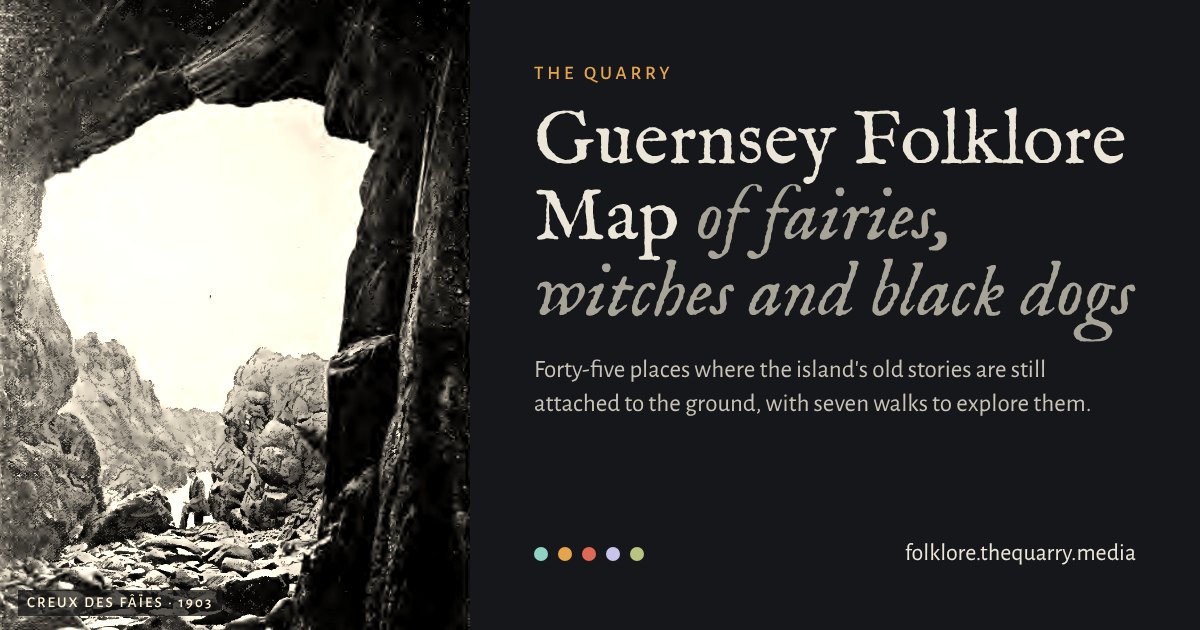
Mann created a Guernsey folklore map for Halloween after seeing Jersey Heritage's version, using AI to source information and build the website with a walking route map.
 Published by The Quarry
On generic AI content, Mann sees it as an opportunity: "AI is okay. It's good at producing stuff at volume, but generative AI, by its very nature, goes to the middle ground... I see this as an opportunity for good quality, verified, trustworthy information being of even higher value than it's ever been before."
The discussion raised critical concerns about how the next generation will gain experience. An audience member aksed: with AI eliminating entry-level tasks, how will young people learn through "struggle and trial and difficulty to actually understand what is good"?
Davidson responded that traditional tech pack departments of eight people including managers have been eliminated, but aspiring designers shouldn't enter through technical roles anyway. "You need to come in as a design room assistant, not as the... what the AI is doing, which is the tech side. You need to come in the design room. You need to learn about fabrics. You need to learn about drapes," she said, advocating for "old-fashioned apprenticeships."
Langford acknowledged that "for the first two years of my career... I don't think I added much value whatsoever" doing scanning and wet proofs, but noted new employees now "within a few weeks... they're sending artwork to print" because process-driven tasks can be taught quickly.
He shared a concerning anecdote about a developer who adopted AI early, eliminating "donkey work" for four developers. The result: "Very quickly they dropped from being able to work eight hours a day to four hours a day" because "they didn't have those moments in between of brain downtime."
"I actually quite like it when I have to do a bit of admin... you can't do anything that's like high functioning all the time. You need a break," Langford added.
Intellectual property threats emerged as a major concern. An audience member highlighted that "IP is now under considerable threat... IP is incredibly important in the creative industry in terms of ownership, and I think that's almost slipping through our fingers at the moment."
The speaker predicted: "The business that you can add value to as creatives ultimately will get smaller and smaller from the amount of people prepared to pay for that authenticity... I think the industry is going to go through hell."
Examples included Towers' Terminator sculpture copied and sold on eBay after sale to a Chinese buyer, Davidson's warning about platforms requiring designers to surrender design rights, and actors selling their image rights with unlimited future use.
Another audience member raised concerns about losing human mistakes in creative work. "Human mistakes are kind of your best friend. You can find some of the best ideas from it," she said, citing examples from radio ad voiceovers, model making, and editing.
"You learn by mucking up. You absolutely do. It's the way to do it," Towers responded, noting that in prop making, "I'm never satisfied with anything I produce. There's always a point where you've got to go, that's enough. I actually can't do anymore."
Mauger added: "What you're describing is what makes creativity fun. It's all about trying and working stuff out."
The audience member also questioned the emphasis on speed: "Why do we have to be so quick? You know, why can't we just like take a second and enjoy the process."
Mann responded: "I guess we're all trying to buy ourselves time to do the fun stuff... I'm trying to find myself time to go and research in archives because that's what I like [and what AI cannot do]."
Langford emphasised that all tools have historically sped up certain processes, suggesting creatives "have to think a bit more about which are the bits that you do enjoy, and not outsourcing those bits."
On whether AI will make creativity more or less valuable, Langford predicted it would become more valuable. "It's never been easier for anybody to create anything, but most of it's going to be awful," he said, drawing comparison to social media's democratisation.
He used the example of writing a legal contract with AI: "Any one of us in this room today could write a legal contract for ourselves using AI. The question is, would we trust it to protect us?" The same logic applies to creativity — creating architectural drawings with AI doesn't mean they'll "actually work in practice" without expertise and experience.
"A lot of people will start creating a lot of things, and it'll mainly look rubbish. And the rest of us who have the experience and have the expertise will be ones who are in demand because the businesses... they need to stand out. They need to differentiate," Langford concluded.
Mauger viewed it as evolution rather than death. "Filmmaking today is not like filmmaking in the 1970s," he said. "At the heart of it is storytelling... going back in time to sat around the fire pit where we tell and share stories and we make things up and tell ghost stories... This isn't changing. It's just how we make it and we deliver it."
He acknowledged job losses — "Some jobs in film now won't exist" — but noted "there are jobs now in film that didn't exist 30 years ago."
"The important thing is that we all adapt and we're flexible enough and we're not too fixed mindset, so that we can move with things... At the heart of it, it's humans, it's ideas, and it's executing those ideas. The rest of it is tools," Mauger said.
Rebecca Booth, opening the discussion, emphasised human competitive advantages: "Humans have competitive advantages over AI, which AI cannot replicate, which is creative and original thought. In a study by the World Economic Forum, 1,000 global business leaders cited creativity as the number one skill, rising in importance."
"AI doesn't care about the end results. Why a line matters. Why a story resonates. Why a design delights in its beauty. But as a creative industry, we do," Booth said.
Q&A
Q: How much time does AI save in garment design?
A: According to clothing designer Kay Davidson, drawing a garment specification traditionally took 3-4 hours, but with AI assistance the same tech pack can now be generated in 3-4 minutes, representing an approximate 98% time saving on technical documentation.
Q: What changes has University Arts London made to assessments?
A: UAL no longer accepts essays, assuming they will be AI-generated. The institution now focuses on practical work, allows AI use at project initiation if work is developed further, and has specifically banned Canva for portfolios this year.
Q: How much are actors being offered to clone themselves?
A: Filmmaker Warren Mauger revealed actors are being offered between £20,000 and £30,000 for one day in a studio to be digitally mapped, after which they appear in Instagram posts and TV advertisements, having essentially sold their image rights with unlimited future use.


Comments ()