
States to vote on significant planning changes including nine new affordable housing sites
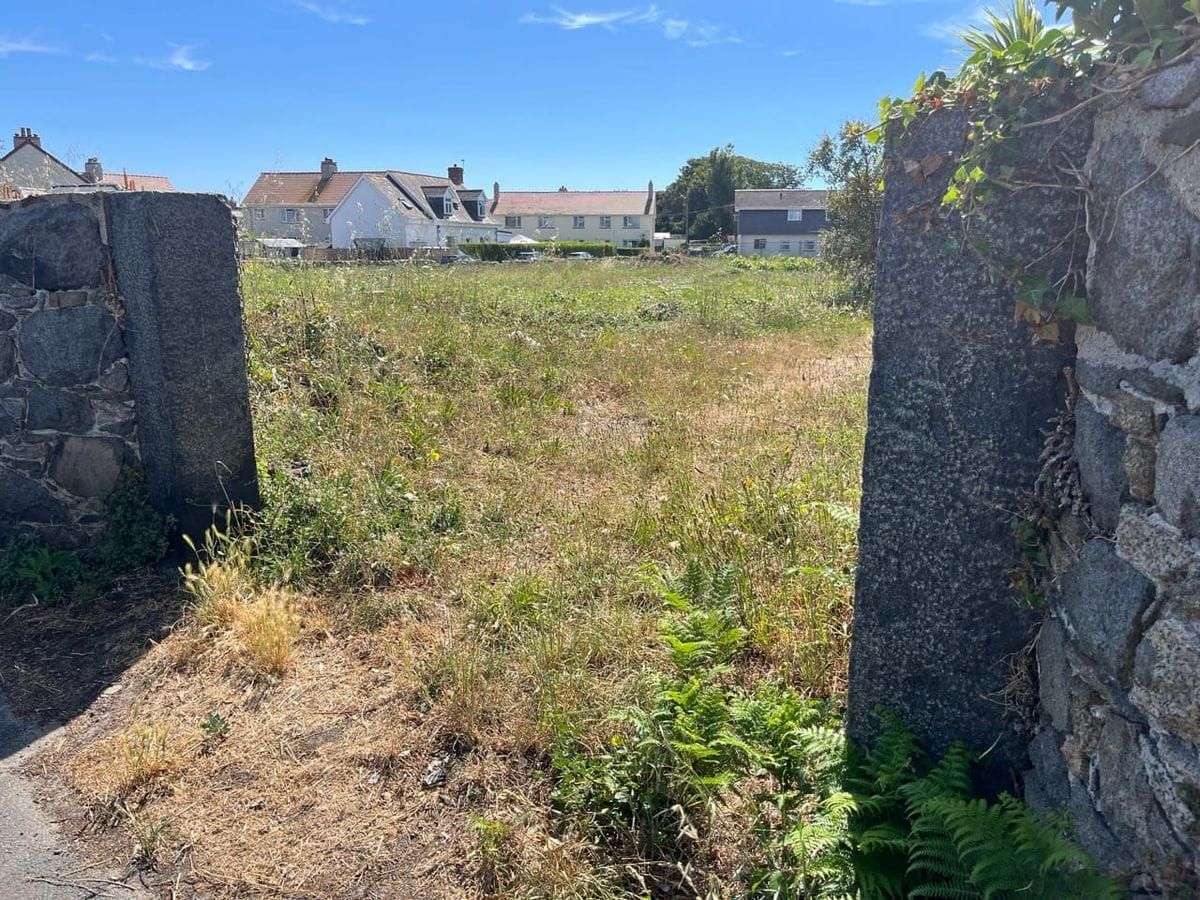
- Nine new sites proposed for approximately 267 affordable homes, with planning permission expected by end of 2027
- Controversial Vazon local centre designation recommended despite independent inspector's opposition over infrastructure and character concerns
- Affordable housing surplus stands at just 72 units after proposed allocations, whilst private market has 665-unit surplus
- DPA rejects five of inspector's 16 recommendations, including additional affordable housing sites on agricultural land
- Major employment land changes include redesignating Saltpans for mixed-use development and switching Belgrave Vinery to industrial use
Guernsey's States will vote on significant changes to the Island Development Plan that propose nine new sites for affordable housing and a controversial local centre at Vazon, despite opposition from an independent planning inspector.
The Development & Planning Authority has presented a review addressing critical housing shortfalls through 2030, with the proposals the most significant changes to Guernsey's planning framework since the plan's adoption in 2016.
According to the latest Strategic Housing Indicator published in November 2024, Guernsey needs 1,488 homes between 2024 and 2028, comprising 815 private market dwellings and 673 affordable housing units. The DPA has set targets through 2030 of 1,062 private market and 976 affordable housing units, including buffers.
Whilst sufficient land exists for private market housing, with a surplus of 665 units, the situation for affordable housing is significantly tighter. Current supply shows 1,048 affordable units available against 976 needed, leaving a surplus of just 72 units after the proposed allocations. Before two additional sites were added, the surplus stood at only 17 units.
The nine Priority Affordable Housing Allocations are expected to deliver approximately 267 affordable homes across the island. The sites comprise Whispers Vinery at Rue Des Goddards in Castel (40 units), Les Caches Farm at Rue Des Caches in St Pierre Du Bois (15 units), Regency Vinery at Steam Mill Lane in St Martin (39 units), Former Fletcher's Freesias at Route Carré in St Sampson (32 units), School Lane Vinery at La Grande Rue in St Martin (40 units), Selbourne Vinery at Route Des Coutanchez in St Peter Port (31 units), Two Acres at La Planque Lane in Forest (26 units), Springhurst House at Le Bourg in Forest (22 units), and land at Sandy Hook in St Sampson (22 units).
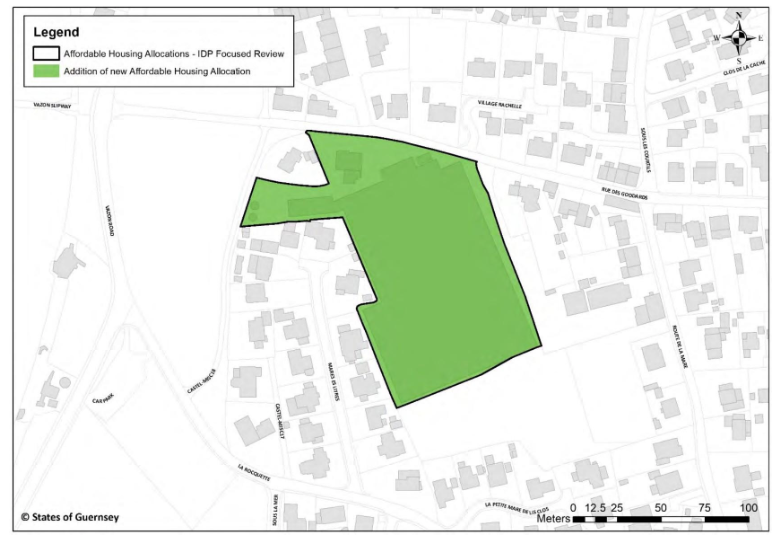
The sites are primarily designated for affordable housing, though some private market housing would be permitted if needed for viability. The majority of dwellings on each site must be affordable housing, requiring viability evidence, Committee for Housing support, and agreement with a registered housing association. Crucially, any amount paid over the benchmark land value cannot be used to justify private market housing.
Planning permission is expected by the end of 2027, with sites failing to progress potentially facing de-allocation in a future review. The DPA deliberately distributed the sites across the island to avoid over-concentration in the Bridge Main Centre area and provide affordable housing opportunities in local communities.
The most controversial proposal concerns the designation of Vazon as a new local centre, intrinsically linked to the Whispers Vinery affordable housing allocation. Without local centre status, the Whispers site would contradict the spatial planning strategy by being located outside the centres.
The DPA stated: "The designation would provide opportunities for community growth, support existing facilities and reinforce the sustainability of the area... A substantial proportion of existing and planned housing development is concentrated in and around the Bridge Main Centre and the northern part of the Island."
However, independent planning inspector Keith Holland recommended rejecting both the Vazon local centre and Whispers Vinery allocation. He concluded that Vazon lacks an identifiable centre, existing facilities are visitor-focused rather than community-focused, and infrastructure, drainage and flood risk concerns remain. He also raised character and traffic concerns at Whispers Vinery.
The authority has rejected this advice, arguing that Vazon possesses "a clear sense of place, functions as a destination for local residents as well as visitors" and infrastructure concerns "can be appropriately managed through the planning application process". The DPA emphasises that the site comprises a redundant glasshouse complex, representing brownfield land that aligns with public consultation preferences.
Protective measures include designating a Vazon Coastal Restricted Development Area due to flood risk, designating coastal grassland as Important Open Land, and requiring the site south of Whispers to provide formal open space.
Inspector Holland examined the draft plan amendments and made 16 recommendations. The DPA fully accepts six, partially accepts five, and rejects five.
Among the key rejected recommendations, the inspector had proposed six additional affordable housing allocations to strengthen what he considered an insufficient 17-unit buffer. The DPA accepted only two of these—Springhurst House and Sandy Hook—whilst rejecting four others.
Land at Route de Carteret in Castel and Le Penage in St Martin were rejected as no longer available. A field at the rear of L'Aumone House in Castel was rejected because it is designated as an Agriculture Priority Area, described as "some of the best agricultural land on the island". Land at the rear of Cranfield House in St Sampson was rejected as it has been proposed as an Area of Biodiversity Importance and "contributes to the hidden countryside".
The authority stated: "The consultation feedback received through the representations shows a clear consensus not to use agricultural land or open land but rather prioritise the re-use of brownfield land and redundant vineries before such sites."
The inspector also recommended that Priority Affordable Housing Allocations should not have planning permissions renewed if development has not progressed. The DPA rejected this as "problematic", favouring site de-allocation through an IDP amendment instead.
Another rejected recommendation concerned Policy GP11 thresholds. The inspector recommended lowering the affordable housing requirement threshold from 20 or more dwellings to five or more. The DPA rejected this, keeping it at zero per cent as a contingency only, pending a full IDP review.
The authority has expressed concern about the allocations, stating: "The DPA is concerned that these allocations may result in a trail of undeveloped land allocated for Affordable Housing and pressure in the future for further sites to be allocated if the sites do not materialise."
To address this, a monitoring framework will include a formal review of Priority Affordable Housing Allocations if planning permission is not secured by the end of 2027. Sites failing to progress may be de-allocated and replaced with alternatives, subject to States approval. Updated supplementary planning guidance will detail viability requirements, milestones and delivery expectations.
Policy GP11 is being retained as a fallback mechanism. Currently requiring zero per cent affordable housing in developments of 20 or more units, it will remain as a contingency if the Priority Allocations fail to deliver. The DPA stated: "This will ensure that an alternative policy tool remains available should the proposed Priority Affordable Housing Allocations fail to deliver as anticipated."
Significant changes are also proposed for employment land. All undeveloped land at Saltpans Key Industrial Area would be redesignated as a Mixed-Use Development Area, primarily for affordable housing, with a minimum 25 per cent for complementary community, recreational and commercial uses. New Policy MC12 would specifically govern Saltpans MUDA development.
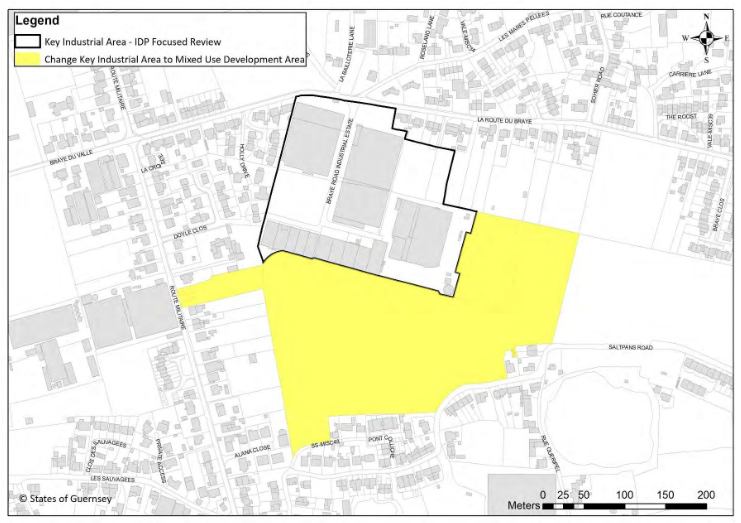
To compensate, Belgrave Vinery would switch from a housing allocation to a Key Industrial Area for industrial and storage use, providing sufficient industry and storage land for five years or more. Lowlands Industrial Estate would be designated as a business park to protect employment uses.
Other employment changes include simplified requirements for industrial use changes along the Inter-Harbour Route, removal of the redundant building requirement for industrial uses in main centres, and a streamlined release mechanism for Key Industrial Expansion Areas, incorporating updated forecasts from the Employment Land Study 2023.
The inspector concluded the employment land proposals are "soundly based" and made no recommendations.
The authority also proposes extending the L'Aumone Local Centre boundary to include a new Redevelopment Area comprising Castel Hospital, Perruque House and King Edward VII Hospital sites. The rationale is to provide greater flexibility to respond to housing demands, contribute to affordable housing, and efficiently redevelop sites whilst improving the local centre. Two areas of undeveloped land within the expanded boundary would be designated as Important Open Land. The inspector made no recommendations on this proposal.
Following a 2016 commitment to update Areas of Biodiversity Importance based on extensive new research, the proposals would remove two existing ABIs at Fosse Andre West and Les Vardes, retain three ABIs previously proposed for removal at Les Effards, La Hougue du Pommier East and Fosse Andre East, amend boundaries of 18 existing ABIs, and designate 52 new ABIs.
Several contentious biodiversity sites have emerged. For Les Paas, Rue Des Pres ABI, the inspector recommended removing both the curtilage and top paddock (a former glasshouse area), but the DPA has only partially accepted this, removing the curtilage but retaining the top paddock designation.
For Noirmont Quarry ABI, the inspector recommended retaining it but excluding hardstanding areas. The DPA has partially accepted this with boundary revisions. The inspector recommended not adding two adjacent fields to Les Tracheries ABI due to "inadequate justification", but the DPA has rejected this advice, stating both fields should be designated following Environment Guernsey's recommendation.
For Rope Walk ABI, the inspector recommended excluding a parcel with planning permission for three dwellings, which the DPA has accepted. For La Garenne d'Anneville ABI, the inspector recommended reducing the area to the north-west, removing grassland lacking ecological credentials, which has also been accepted.
The proposals simplify the system for determining when development frameworks are required. Instead of complex thresholds, a specific list of sites requiring frameworks would be maintained in Annex III, with all other sites assessed case by case. The focus would be on sites where frameworks provide the most benefit for coordinated development. The inspector agreed these proposals are "soundly based" and made no recommendations.
Minor amendments include site changes such as removing Le Va from Saltpans (Parc Le Lacheur) Housing Allocation and removing L'Étoile Potager from the St Sampson and Vale Main Centre boundary, the latter against the inspector's recommendation to retain it. Policy GP12 would be amended to allow flats in large office buildings to convert to offices in certain circumstances, alongside various text clarifications and map corrections.
The proposals have been prepared under the Land Planning and Development (Guernsey) Law, 2005 and Land Planning and Development (Plans) Ordinance, 2007. The proposed amendments have been screened and determined not to require an environmental impact assessment.
The consultation process included initial representations, extended initial representations, further representations and a public planning inquiry hearing. A total of 919 representations were received, with the DPA providing written responses to each. The Committee for Environment & Infrastructure has certified the proposals are consistent with the Strategic Land Use Plan adopted in 2011.
If approved, the amendments would become operative immediately and the plan would be known as the Island Development Plan (Review 1, 2026). Planning permission for Priority Affordable Housing Allocations is expected by the end of 2027, with the review mechanism triggering if permissions are not secured. A full IDP review is expected before the end of 2030 following a Strategic Land Use Plan review. If not approved, the current IDP remains in force through 2030, having been recently extended by the States.
The States are asked to vote on ten propositions. Propositions one to nine seek individual approval of each Priority Affordable Housing Allocation, including the Vazon Local Centre with Whispers Vinery. Proposition ten seeks approval of all other proposed plan amendments, subject to approval of propositions one to nine.
The authority stated: "The DPA therefore recommends that the States approve its Proposed Plan Amendments to ensure the Island Development Plan remains effective, responsive and capable of meeting the Island's future needs."
Q&A
Q: How many affordable homes are proposed in the new allocations?
A: The nine Priority Affordable Housing Allocations are expected to deliver approximately 267 affordable homes across various sites in Guernsey, with planning permission expected by the end of 2027.
Q: Why is the Vazon local centre controversial?
A: Independent planning inspector Keith Holland recommended rejecting the Vazon local centre designation, concluding that Vazon lacks an identifiable centre, existing facilities are visitor-focused rather than community-focused, and infrastructure, drainage and flood risk concerns remain. The DPA has rejected this advice.
Q: What is the current affordable housing surplus?
A: After the proposed allocations, the affordable housing surplus stands at 72 units (1,048 units available versus 976 needed through 2030). Before two additional sites were added, the surplus was only 17 units.


Comments ()