
Overall cancer rates in Guernsey significantly higher than England, the South West and Jersey

- Public Health Services in Guernsey and Jersey release Channel Islands Cancer Report.
- The report provides cancer incidence and mortality data up to 2022.
- Average of 735 malignant cancers registered annually between 2020 and 2022.
- 36% are non-melanoma skin cancers.
- Public Health Services encourage residents to adopt healthy lifestyle practices to reduce cancer risk.
New data shows statistically significantly higher overall cancer rates in Guernsey when compared to England, the South West and Jersey.
Public Health Services in Guernsey and Jersey have published the ‘Channel Islands Cancer Report; incorporating data up to 2022’, presenting new insights into cancer incidence and mortality.
Compiled by the National Disease Registration Service, part of NHS England, it marks the third release in a series aimed at reducing the reporting lag of cancer data.
“We can draw reassurance from Guernsey’s incidence rates for most cancer sites continuing to be similar to or lower than comparison areas,” said Jenny Cataroche, Head of Public Health Intelligence.
“There are five cancer sites, however, plus the level of all cancers combined, where local rates are calculated to be higher than England and/or the South West.
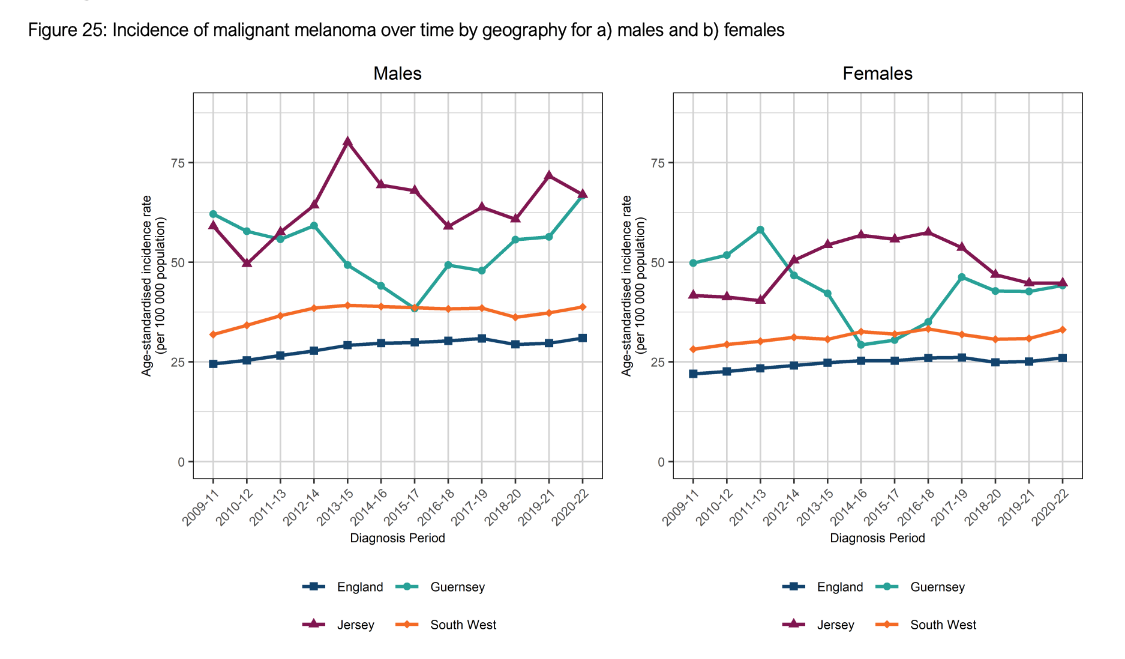
“We continue to see significantly higher rates of malignant melanoma and non-melanoma skin cancers than nearby areas. The major risk factor for these cancers is UV exposure from the sun or sun beds which is why it’s so important to follow sun safety advice.”
Findings from the report for Guernsey, including Alderney, include:
- An average of 735 malignant cancers were registered each year between 2020 and 2022.
- The five most commonly diagnosed cancers, in rank order, are non-melanoma skin cancer, prostate cancer, breast cancer, colorectal cancer, and lung cancer.
- The leading causes of cancer-related mortality are lung cancer, prostate cancer, upper gastrointestinal cancer, breast cancer, and colorectal cancer.
- The age-standardised rate for all cancers combined (excluding non-melanoma skin cancers) is significantly higher than that for England and the South West region.
- Cancer incidence rates for kidney and ureter, and uterus cancers are lower than in comparison areas, specifically the Southwest region and England.
- There was an average of 179 deaths due to malignant cancers registered each year between 2020 and 2022.
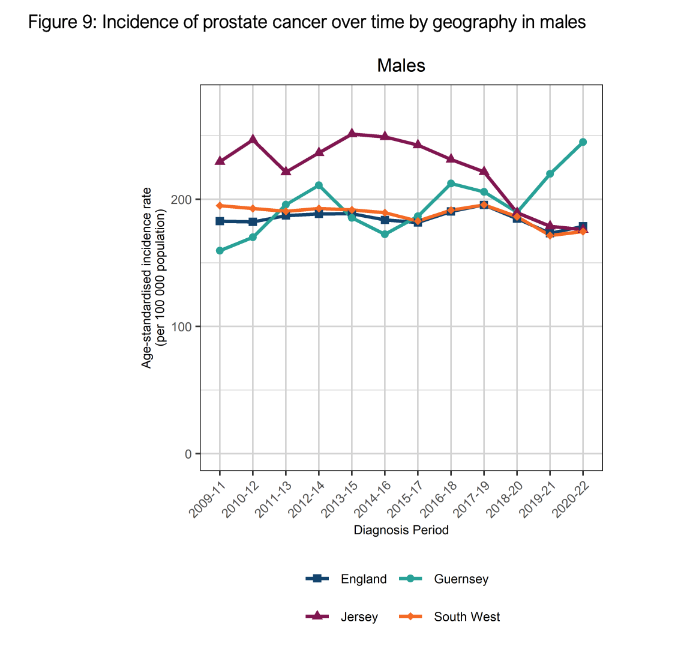
The report identifies cancers for which local incidence significantly exceed those of comparison areas: non-melanoma skin cancer, malignant melanoma, lymphoma, male urogenital cancer (excluding prostate), and prostate cancer.
Alex Hawkins-Drew, Associate Director of Public Health, said: “Not all cancers can be prevented, but many - around four in every 10 cases - can.”
He reiterated the necessity of lifestyle changes such as stopping smoking, maintaining a healthy weight, reducing alcohol intake, and safe sun practices.
Hawkins-Drew added that Public Health is committed to advocating for legislative changes, such as the recent ban on smoking in cars with children, aiming to create an environment where residents can minimise cancer risks.
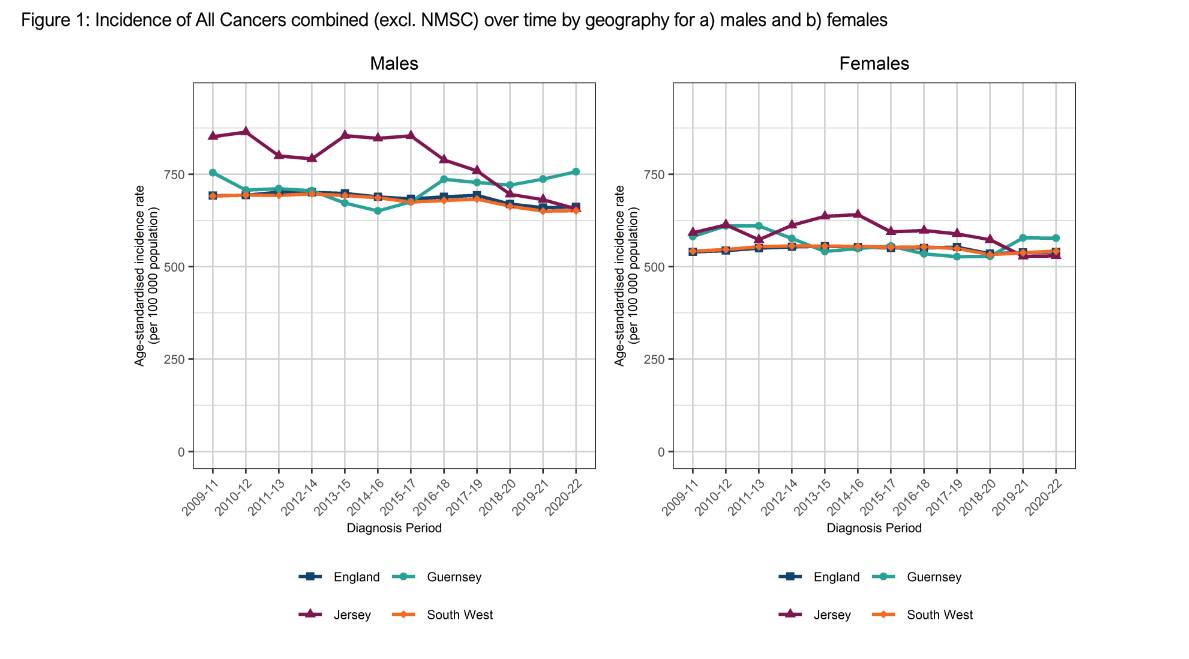
The age-standardised rate of all cancer combined (excluding NMSC) in Guernsey is 667 per 100,000 population.
This is a statistical measure used to compare health outcomes between different populations by adjusting for differences in their age structures. It provides a summary rate as if the populations had the same age distribution.
The rate in Jersey is 593, the Southwest is 597 per 100,000 and in England is 601 per 100,000.
Around 471 new cases in Guernsey are diagnosed each year.
The age specific rates show that from age 55-59 years, males have a higher incidence of cancer than females.
The complete report is accessible at: https://gov.gg/publichealthinfo.
For more on sun safety: https://www.cancerresearchuk.org/about-cancer/skin-cancer
Future publications will adhere to a biennial reporting cycle, with the next report projected for 2027, which will include data up to 2024.

Comments ()