
Maintaining mobility, maintaining independence - the new group exercise programme for over 65s
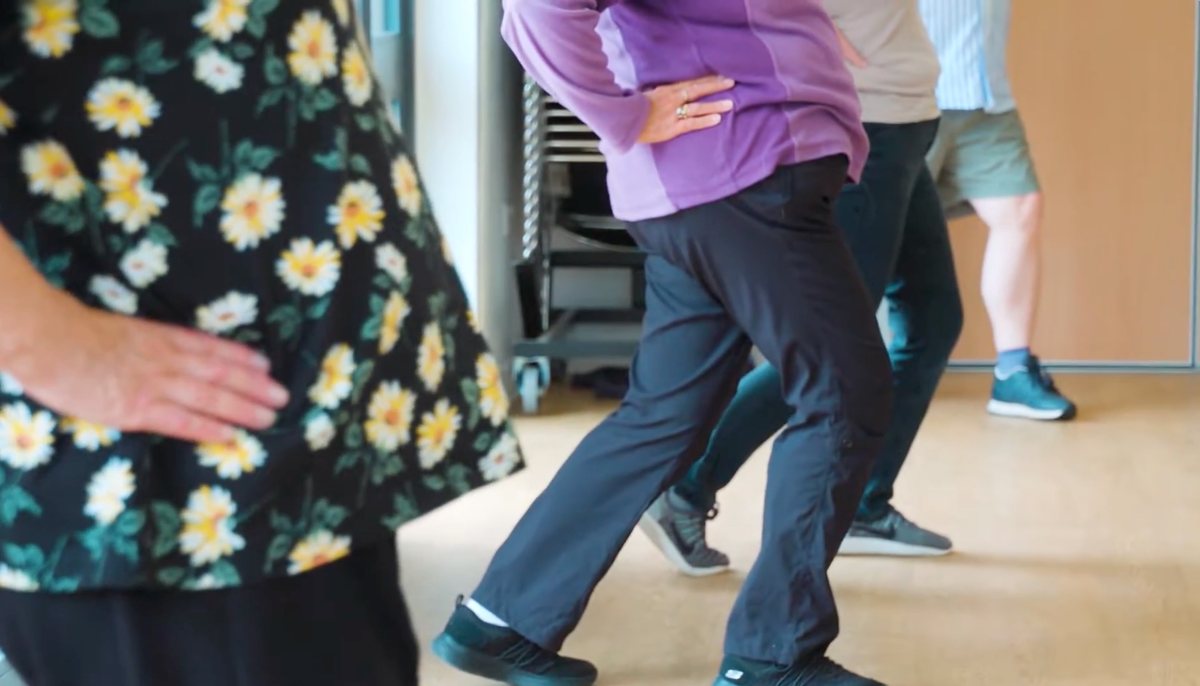
- New free group exercise programme for people aged 65 and over begins in February.
- It combines exercise, education and social activities designed for older adults starting to show mobility decline.
- It is designed to help people build physical activity into their lives and maintain the habit.
- Evidence from four-and-a-half year study shows how effective the programme is.
When mobility problems start to kick in, the effects on someone’s life can be profound.
They lose independence, lose the ability to do things that they value the most, are less likely to leave their homes, socialise less.
That is the personal, the bigger picture is the costs of the healthcare interventions that are then needed.
With an aging demographic, preventative measures become ever more important.
Now a new group exercise programme called React has been brought to Guernsey by the Health Improvement Commission, aiming to help before major limitations take hold and give people lifestyle changes that stick.
It lasts 12 months, with sessions beginning twice weekly before moving to once a week after the first three months.
React Chief Investigator Afroditi Stathi, a professor of Physical Activity and Community Health at Birmingham University, has been involved in evaluating exercise schemes for older adults for decades.
The birth of React can be traced to her frustration with a major research project that initially gave people a lot of support. When it ended, the vast majority went back home and did not keep the exercises going.
“That, for me, was the line, I said, ‘I don't want to be involved in anything that does that to people’. I wanted to bring research together to identify programs and ideas that will help people to start exercise, be more active, but more importantly, to maintain that in the long term. So we prepare people so they can go out and they can continue when any program finishes.”
That was in 2006 and sparked her to put together a network of academics, non academics and older people to think about what could work.
“We thought just go back to the basics, give people reasons and opportunities and the confidence to open the front door and get out and engage more with their communities, and that would be a great starting point.”
As of the end of 2023, there were 13,614 people aged 65 and above in Guernsey, up from 11,375 in 2007.
Life expectancy at birth for the period 2019 to 2021 was 83.4 years, but people lived in full health for only 63.6 years of that.
The 2025 Quality of Life report recorded levels of intense social loneliness at 32.7% for 65- to 74-year-olds in Guernsey.
The 65 and above age bracket was chosen because of the epidemiological data showing mobility limitations kick in more and more as we age.
The programme is aimed at the “middle ground”, people that might feel a bit of difficulty when going up and down stairs or getting up from a chair for example.
It has been validated through a randomised control trial which had 777 people participating in Bristol/Bath, Birmingham and Devon over four and a half years.
Those in the intervention group followed the programme for 12 months, which meant 64 exercise sessions with strength, mobility, balance and aerobic components.
“The strong component, and a very unique component for the program, is what we call the social educational or the health behavioral maintenance program.
“So from day one, when a participant comes to React, after each exercise session, there is a social time.
“There is more structure at the beginning and then when people develop the group they can lead these discussions.
“We also have a very structured maintenance program we deliver once a month taking advantage of people being in a group with their instructor. They discuss barriers, what gets in the way, exchange ideas about how they have overcome barriers, so giving ideas to other people in the group and also what else people can do. It's not only about coming to the React program, but using React as the anchor. From that point, they go out and they do try other things. It might be an indoor activity, it might be outdoors.”
In Guernsey there are plenty of opportunities, but someone needs the ability and confidence to start.
The structure of the programme, two sessions a week for the first 12 weeks and then reducing down to one helps achieve that flow of building confidence and then people finding another activity to fill the other hour.
A key question for the original trial was about whether people maintained mobility in the long term.
Evidence showed they did.
“This is an extremely important message for older people who might think it's too late, there is nothing to be done.
“Actually, there is a lot to be done. The mean age of people who were in the trial was 78. We had participants in their 90s, and they stayed in the program. They improved. So that's a powerful message for people. You can do something at any point.”
Since the original trial the programme has continued to be delivered in Bristol.
From February it expands to south Gloucestershire, north Somerset, north and central London.
It will also be delivered with funding from the English Football League in the Community at six clubs, including Bristol City, Bristol Rovers and QPR.
“The people who came to the program, they visited their doctor less often, and they were also hospitalized less often, than the control group, which has massive financial implications for the NHS in England or any health system.”
HIC’s Adult Physical Activity Officer Sam Green said they were fortunate to have the funding support of the Guernsey Community Foundation, which has covered set up costs, buying equipment and training seven instructors.
The money means they can run two programmes this year, with applications still open.
It means 30 people can be supported by the initial wave of React.
“A lot of the research about the impact and the evidence has already been done with the large scale trial. So in terms of what success would look like for us, it would be people moving through the program, us filling the programs, people being active after the programs, the program growing. So it's not just one or two programs, it's an ongoing thing, we have React in Guernsey, and it's growing and it's staying on the island.”
Who is it for?
REACT is for adults aged 65+ who are finding everyday activities—like climbing stairs or getting up from a chair—more challenging than before.
It’s suitable for those who want to improve their strength, balance and confidence in everyday movement, and who wish to maintain independence and reduce the risk of future mobility problems. It’s not designed for people who are already very active or those who need intensive rehabilitation.
It’s completely free, and applications for the first programme (starting February 2026) are now open.
To find out more, check your eligibility, or apply online, visit here.
Healthcare professionals can also refer patients using the same application form.
Comments ()