
The first ever temple to Easter, the first image of a God in the sky, the first direct measure of the equinox: what new evidence is telling us about Le Déhus
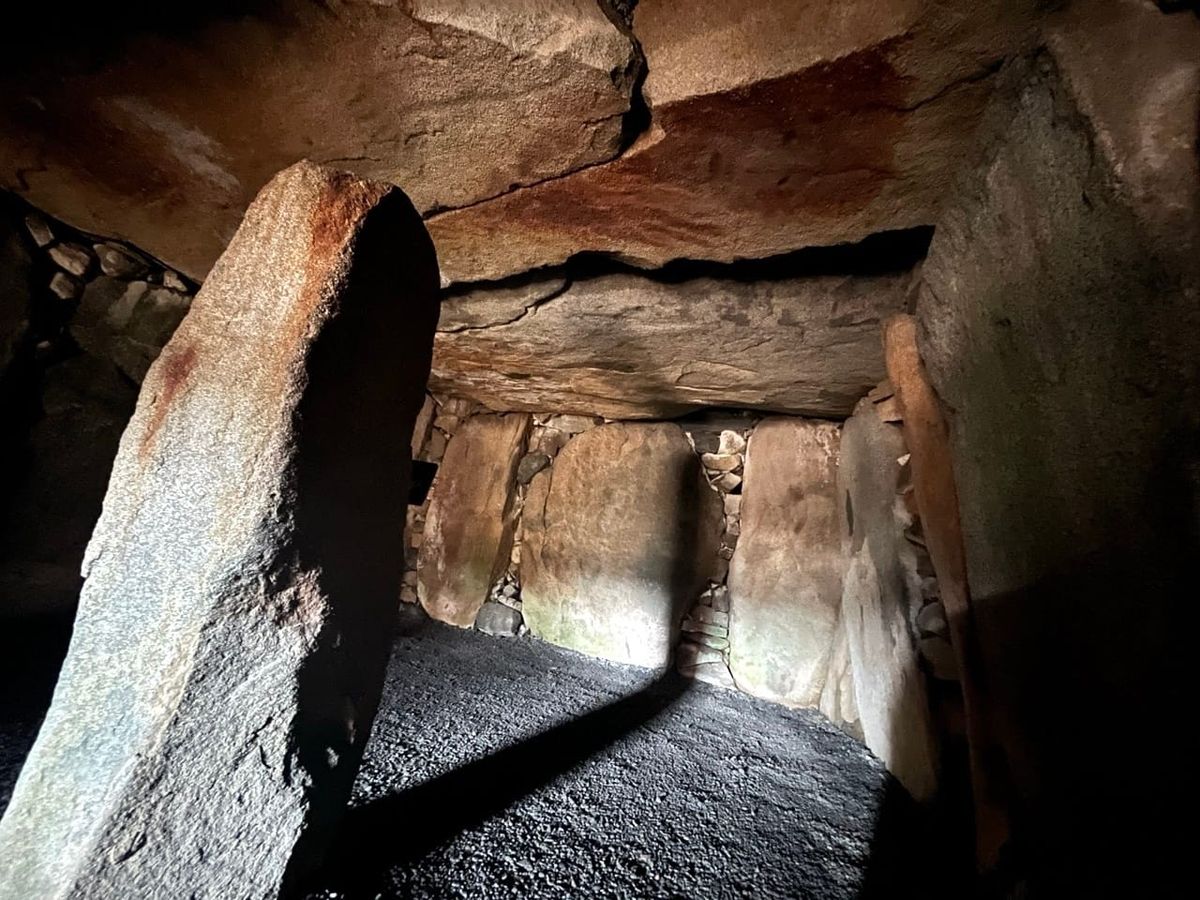
Le Déhus is a quiet, enigmatic place.
You have to duck to get through the low door into the burial chamber, and stooping feels like a small act of respect, forcing you to nod to the people who built it 6,000 years ago on a low hill in the north-east of the island.
Inside it is cold and still, with only the pigeons cooing.
Switch on the lights and, on a capstone above the central chamber, a face looks back at you from the granite: Le Gardien du Tombeau, the guardian of the tomb.
Below it stands a mysterious single stone, and in daytime light floods in from the doorway, casting the stone's shadow across the floor.
It is here that a fascinating story unfolds.
It begins with a new look at hard evidence: geometry, and the movement of the sun and stars. Then the rest is a new interpretation, a hypothesis that aims to make sense of the stone positions and carvings.
Put together, it points to a site of real importance.
A place where the equinox was fixed as a stone calendar, and possibly the earliest direct measurement of earth time; where light and shadow mark the season we now call Easter; and where, carved into the roof, may be the oldest surviving image of a sky-father, the same iconography you can follow all the way through history to Michelangelo's God reaching out to Adam on the ceiling of the Sistine Chapel.
Watch Dig Deeper - The Quarry Live. You can also listen to the recording on Spotify and Apple podcasts.
Martyn Dorey came to Le Déhus by chance, while writing a book on mathematics.
He was working back through the history of the subject, from the Greeks to the Egyptians to the Mesopotamians and the people of the Atlantic seaboard who built the first stone megaliths. Martyn wanted to ask if the megalith builders had an interest in the geometry of the sky.
For research he visited the burial mound at Le Déhus on the winter solstice and was baffled, as none of what he saw made sense.
It was not a solstice alignment. So what was it? At that point Le Déhus caught hold of him and would not let him go.
"It became an obsession," he said during Dig Deeper, The Quarry live in the Café at St James. "To the point where it was almost talking to me. What were these Neolithic people thinking? What were they trying to say? And then I had this moment of realisation."
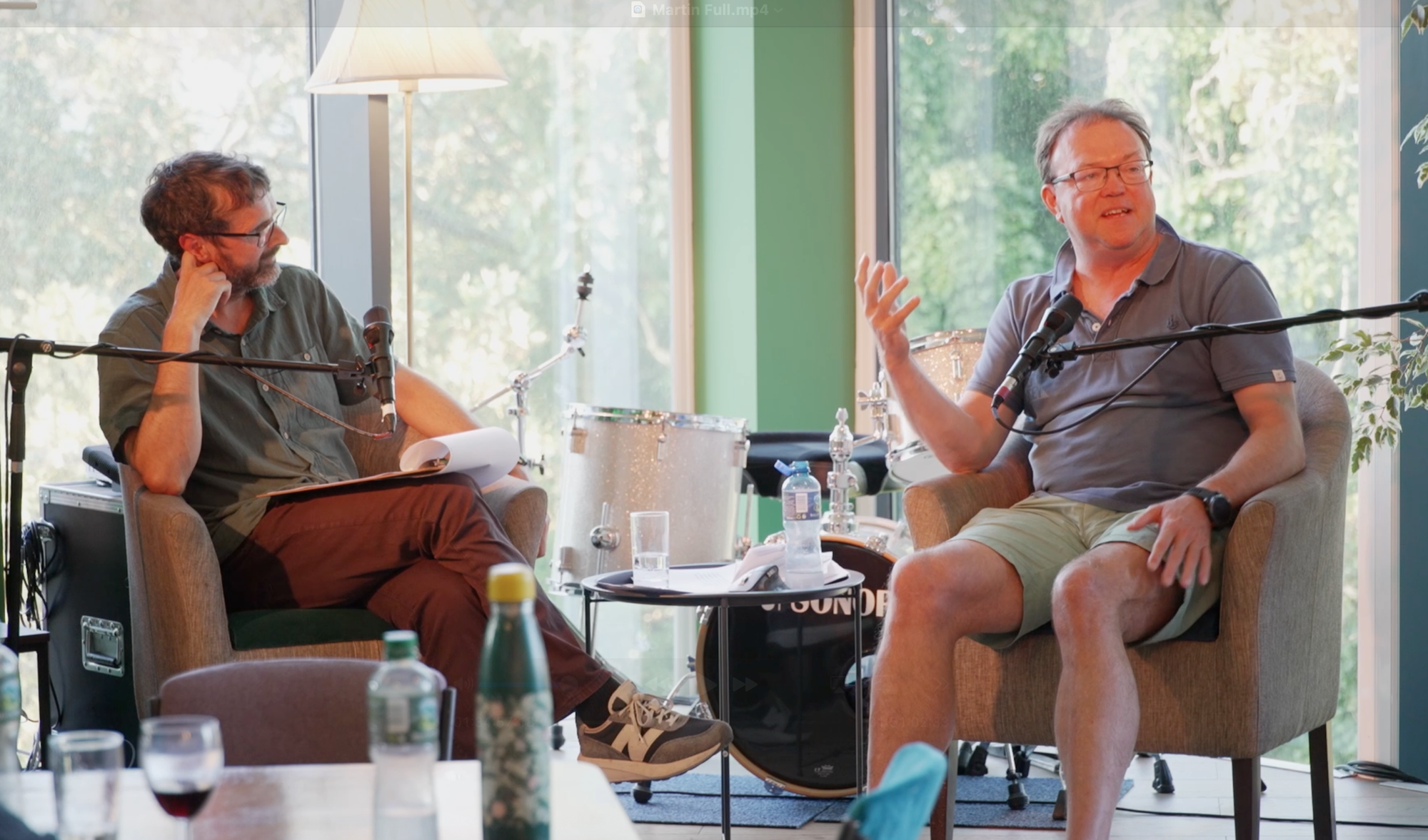
Speaking later, Martyn said:
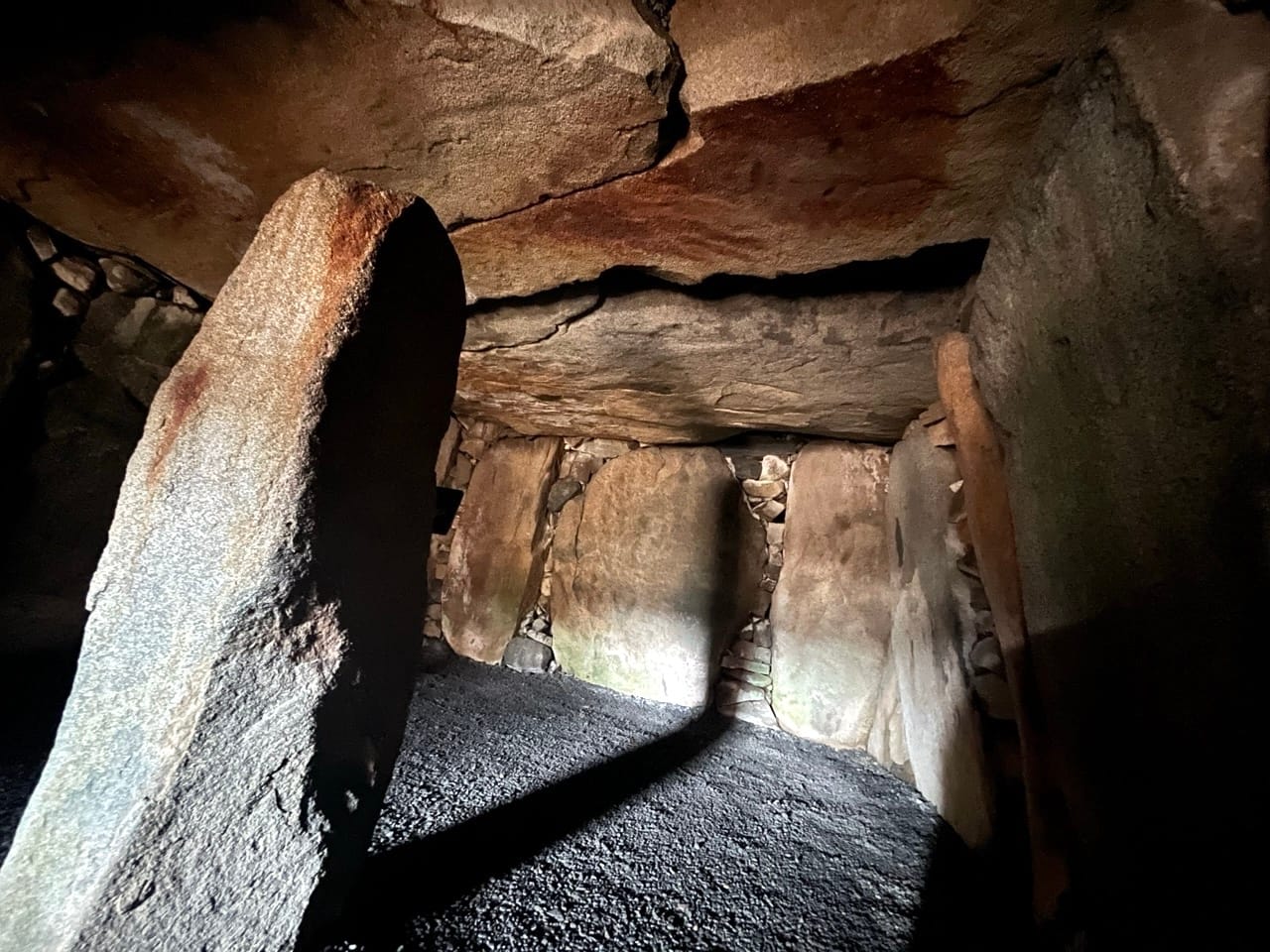
"The standing stone in the middle is aligned perfectly east to west. Turn the lights off in the daytime and you'll see it casts a perfect east-west shadow.
"It's aligned with the equinox, and it could be the first time in history that someone directly marked the equinox. Here the ancient peoples are telling us that shadows on the equinox move in a straight line, and more than that, the equinox measures earth time."
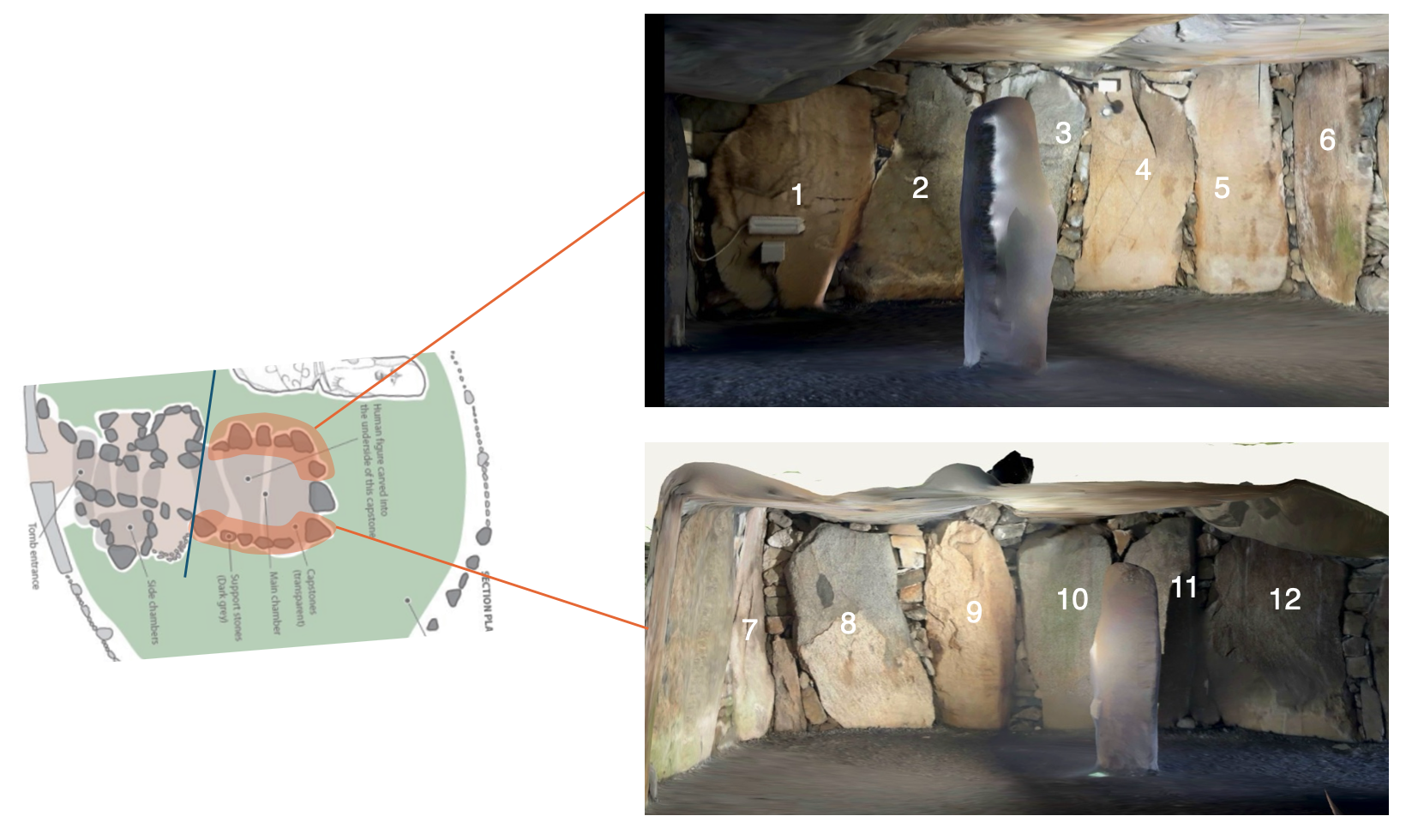
"And then you look around Le Déhus. There's a big sunstone at the back, and 12 other stones around the central standing stone that make up a holy of holies, the most hallowed place of all."
There are typically 12 lunar cycles between the equinoxes, so these 12 stones likely relate to the twelve moons in a year.
To be sure, Martyn came back to Le Déhus on the equinox to check the alignment.
"I thought, 'let's look at this more closely, because it still doesn't quite make sense.' And then on the equinox, suddenly I realised, from the position of the sunstone, that this is a temple for Easter."
How it works - the sunlight
A passage tomb would face due east if it was measuring the equinox. For example, at La Hougue Bie in Jersey, on the equinox, the morning sun falls on a sun stone at the back of the monument. However, at Le Déhus it doesn't. In fact, the passage faces a little to the north of east, and that is the key.
Martyn modelled sunlight and found a spread of days when the early morning sunrise would have run the whole length of the chamber and reached the back of the dolmen. Sunlight is first cast onto the back wall in the weeks just before the equinox and then for a month after equinox.
That's probably a clue as to what the tomb was built for.
How it works - the moon
The first full moon after the spring equinox is called the Paschal moon, and this sets the date for the pagan festival the Church would later choose for Easter.
So light hitting back wall after the equinox gives the range of times in which the first full moon marking Easter can occur.
"That festival was celebrated deep into pagan history," Martyn said. "So this could be the first solid temple to Easter, and that's before you even get to the guardian of the tomb himself."
The carving
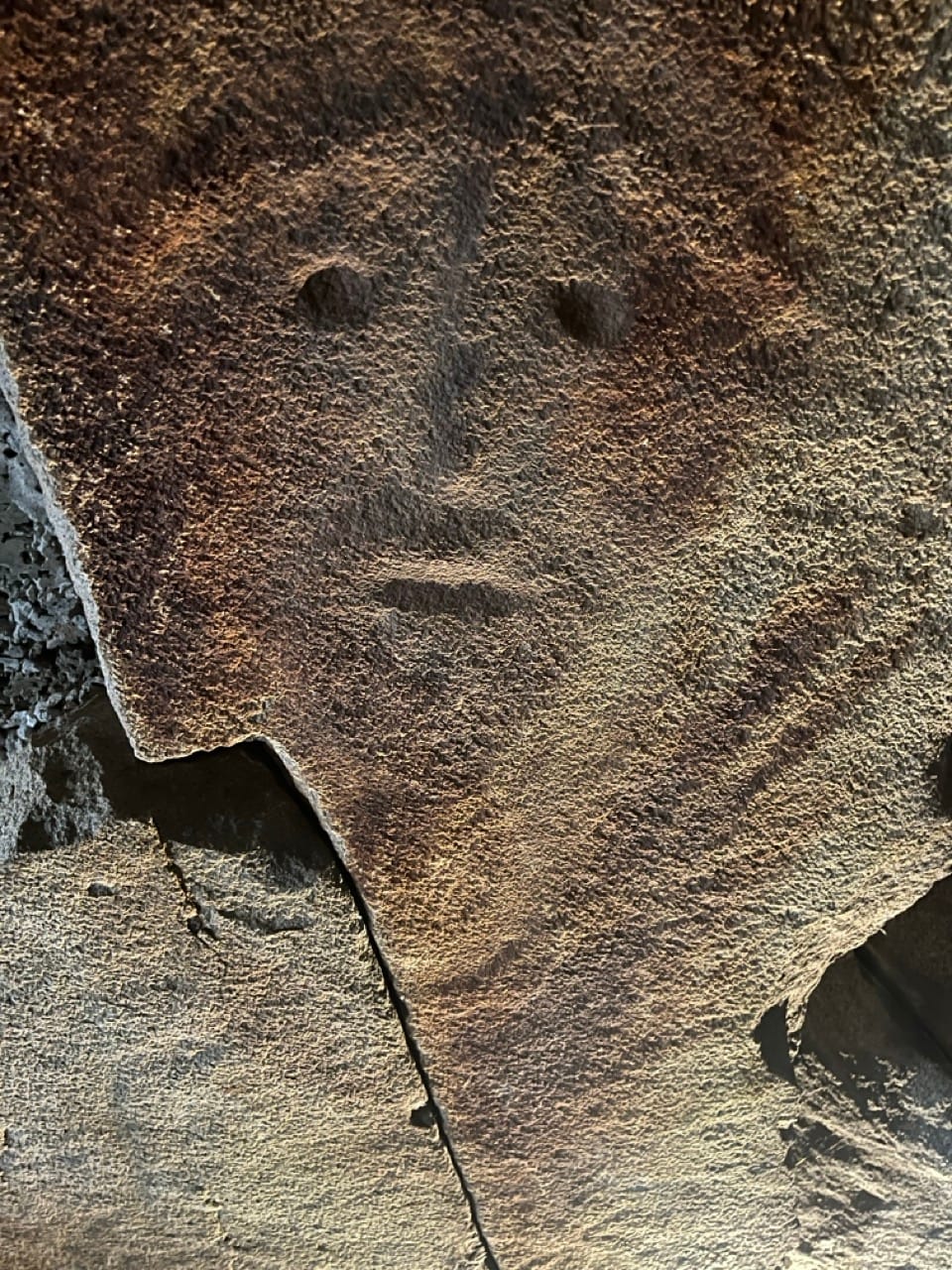
Le Déhus as we see it today has been rebuilt.
It was excavated many times: by F.C. Lukis between 1837 and 1847, the Rev. Lee in 1898, Lieut.-Col. de Guérin in 1915 and Miss V.C.C. Collum in 1932. When Lukis first worked there, the second capstone had broken and was lying on the chamber floor. It was bound back together in 1898, but the carving on its underside was not spotted until 1915.
People have argued ever since about what the carving shows.
One idea is the "Orion hypothesis".
Orion is the hunter of the night sky, a prominent set of stars over Guernsey in winter, listed by the 2nd-century AD astronomer Ptolemy, and named after a hunter in Greek mythology.
To begin to understand the "Orion hypothesis", you need to remember that where the stars appeared in the sky, and where the sun rose on the horizon, were different in 4000 BC from today. There would also have been no road or buildings in the way blocking the sunlight entering Le Déhus, and part of the entrance to the passageway may well also have been higher.
Martyn has modelled all of this, and his calculations suggest that as Orion vanished into the dawn sky each spring, the early light from the sun would have caught the roof carving and brought the face out of the stone about ten days before the spring equinox.
He also points out in relation to the central standing stone that, "standing stones are local symbols of Mother Earth, a Gran'mère."
"At the spring equinox Orion moves into conjunction with the sun in the morning," he said.
"And as Orion joins with the sun, the hunter disappears from view for the summer. Then at the autumn equinox he rises again in the evening night sky to go hunting over winter, exactly mirroring the visibility timings of the Gardien du Tombeau carving.
"Now consider that the standing stone is a symbol of Mother Earth, and you have a representation of Orion moving in line with Mother Earth at the equinox.
"People believed that fertility, the creation of animals, spring, life was created because the Father in the Sky joined and married Mother Earth, and this is echoed across many cultures around the world," Martyn said.
That belief is old and far-reaching.
The marriage of a Sky-Father and an Earth-Mother, from which life is born, is recorded from the Rigveda to the Roman poet Lucretius, and Julius Caesar wrote that the Gauls traced their line to a divine father, Dis Pater, which fits the same Father idea.
It is one of the most widespread creation stories in the world.
The rhythms of life, from knowing when best to plant seeds, when to expect birds to fly over, eggs to be laid, animals to be born, when the tides would be suitable to go fishing or shore gathering, even when to make journeys, or when you can meet at night without artificial light, are bound up in the movement of the sun and moon.
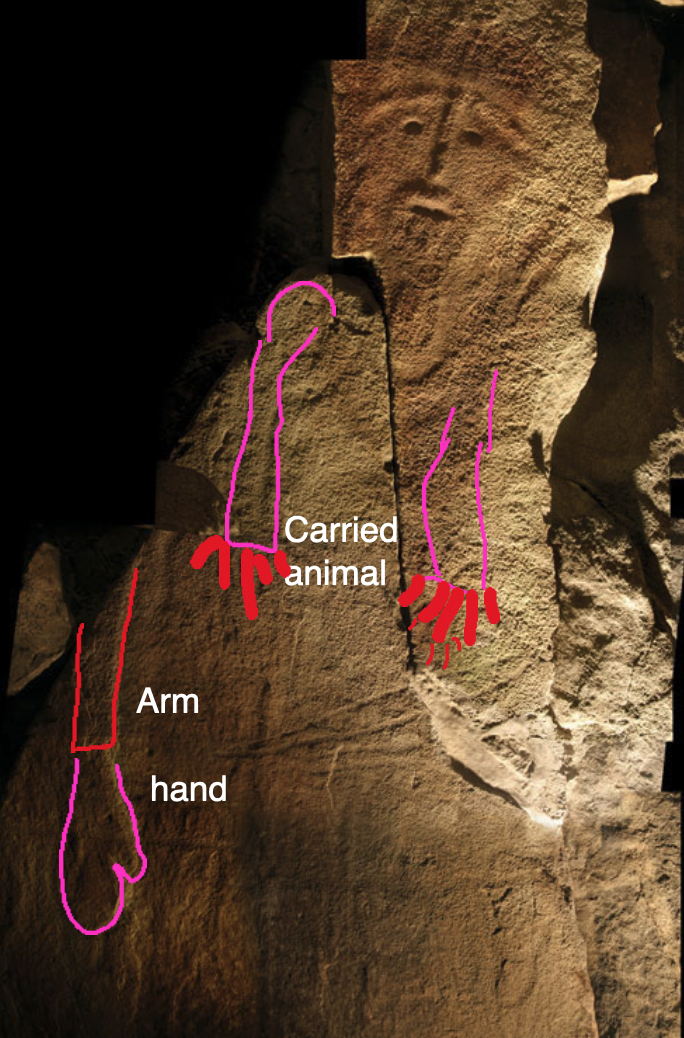
So Martyn believes the figure is Orion, his bow and spear lowered, probably with the arms and claws of an animal around his neck, and it likely represents a hunter returning home from a successful hunt.
The three marks of a belt line up with the three stars of Orion's belt.
He says, "It's fascinating, because of the paths of sunlight and where they strike in the Déhus dolmen. I think the geometry is very secure, and so is the alignment with the sky in 4000 BC."
The name may fit too.
“Its older form is Du Tus, and Déhus, Zeus, Jupiter (Dyeu-pater), Deus, and the word for God all seem to share the same ancient root, meaning sky-light," Martyn said. "The name may be contentious, but locally it may mean the altar of the sky-god: the Déhus Dolmen."
Guernsey at a crossroads
Before Le Déhus was built, Guernsey sat at a crossroads.
Two great movements of Neolithic people had spread out of the Fertile Crescent, the region across the modern Middle East where farming began. They brought crops, tame animals and settled life.
One wave came up the Danube and reached Brittany around 5000 BC. The other travelled along the Mediterranean, through Greece, Italy, Spain, Portugal and up France.
"The Mediterranean neolithic wave intermarried with the hunter-gatherers along their coastal route, and they picked up incredible ideas," Martyn said.
"In Portugal hunter gatherers were using stones to line up the solstice and the equinox on the horizon, and probably celebrating the full moon after the equinox too.
"Then something amazing happened. As the Mediterranean neolithic wave moved north into Brittany the two Neolithic peoples met, groups that hadn't seen each other for thousands of years. There was a huge cultural explosion.
"They also met an extraordinary hunter-gatherer people in Brittany who were doing things in stone no one had seen: they had built huge fish traps, 120 metres long and 20 metres wide, in the tidal areas. The knowledge required to build stone traps may have been repurposed to build megaliths.
"Within a couple of generations these peoples were all intermarrying, and you had this melting pot. And then that group, and you can see this in the genetics, went on to colonise England and Ireland and beyond, becoming the people who built passage tombs like Newgrange, in County Meath."
Martyn thinks Guernsey mattered to these people, and one question nagged at him: why would a small island sit so close to the heart of it?
"As far as I know they didn't have sails. They would have paddled. And what we have on our doorstep are these very strong tides," he said.
"Provisional tidal calculations suggest that you can get from Brittany to England about 35% faster if you stop off at Guernsey and ride the tides. We had a way of speeding up travel between Brittany and Britain, and it was all happening here.
“I suspect that Le Déhus still has so much more to give up."
An opportunity
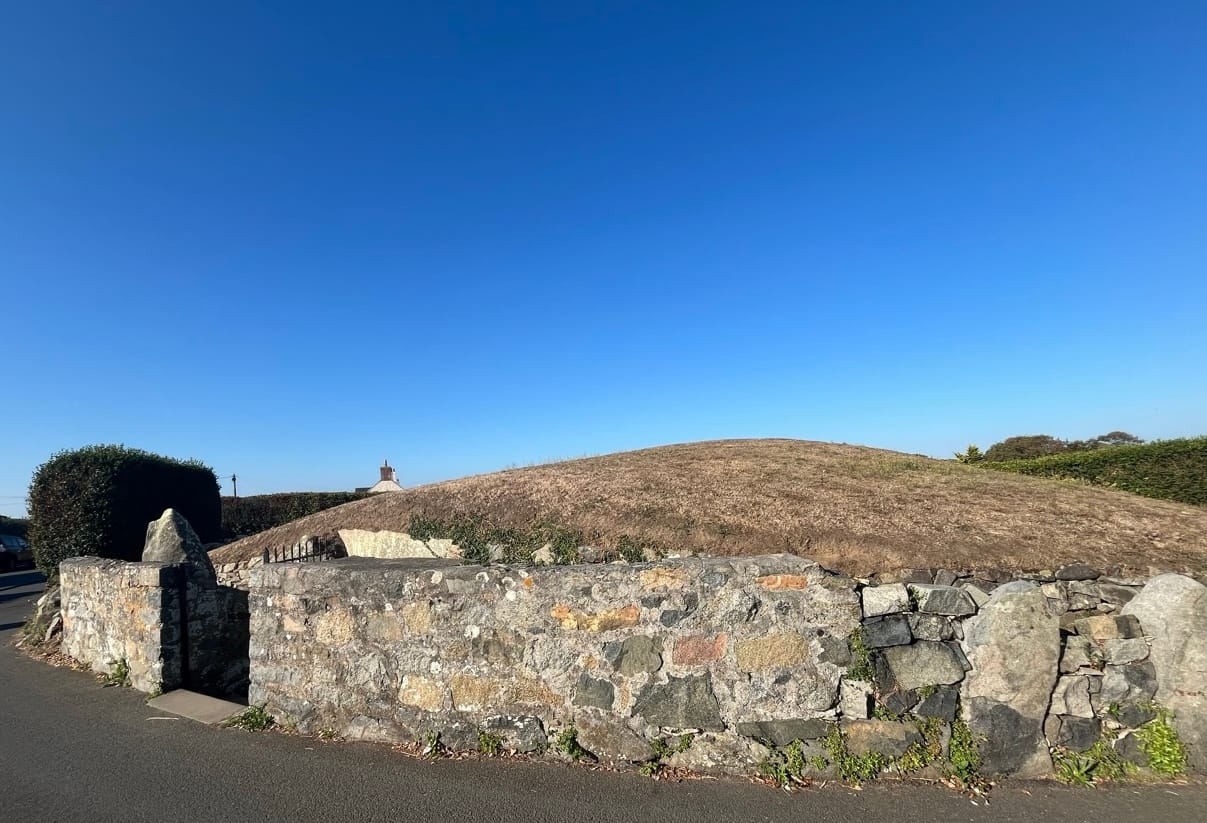
Today Le Déhus does almost nothing for the island's economy.
That is a striking contrast with sites of similar importance elsewhere.
"I think it's one of the most significant places in history," Martyn said. "The Sistine Chapel ceiling, God giving life to Adam, is one of the most valuable images in the world. It probably earns around £20 million a year. And Le Déhus, as far as I know, is the first solid image of the Father in the Sky, of God as we picture him today."
For comparison, La Hougue Bie in Jersey, built around the same time but catching light instead of shadow to mark the equinox, perhaps draws about 30,000 visitors a year. Other European sites of the same age, without the carved art, can see 200,000.
"At the top end you might have 200,000 visitors a year. More cautiously, somewhere between 50 and 75,000," Martyn said. "At the moment it's doing nothing for us. But with recognition and a small visitor centre, it could be worth somewhere between £3 million and £10 million to the island."
He would like a trust set up to make that happen, moving the road and restoring the chamber to bring back its original structure. He can even picture returning two skeletons found kneeling shoulder to shoulder in a side chamber, one facing forwards and one back, strong symbolism linked to Janus, the two-faced pagan god of the doorway between this world and the next.
For Martyn, the project is low-hanging fruit, and the meaning behind it runs deep.
"For me, Le Déhus is the birth of geometry," he said.
"People measured time on Earth using the equinox until around the turn of the millennium, when the International Astronomical Union set it aside in favour of distant quasars. But Le Déhus has been doing it for six thousand years. Every day, as long as there is light, a shadow falls east to west and marks the equinox.
"And just consider that in folklore across the Atlantic seaboard, standing stones are said to be powerful female ancestors, and they are said to travel through time.
"That is exactly what is happening inside Le Déhus. This central stone, I would call her a Gran'mère, is time-travelling, because she is held forever at the equinox."
Comments ()