
Housing under construction reaches five-year high, but a massive acceleration in completions is still needed if States is to hit its goals
- 355 homes were under construction in Guernsey in the last quarter of 2025.
- This figure is the highest for five years and exceeds the 10-year average by 34 homes.
- In 2025, planning permissions for homes reached the highest levels since 2016.
- 113 homes received full planning permission in the final quarter, mostly in St Peter Port.
- Authorities are developing a plan for multi-generational living and looking to fast-track larger sites.
A sharp increase in the pipeline of planned housing was recorded in the final quarter of 2025, but a surge in actually completing projects is needed if States ambitions are to be met.
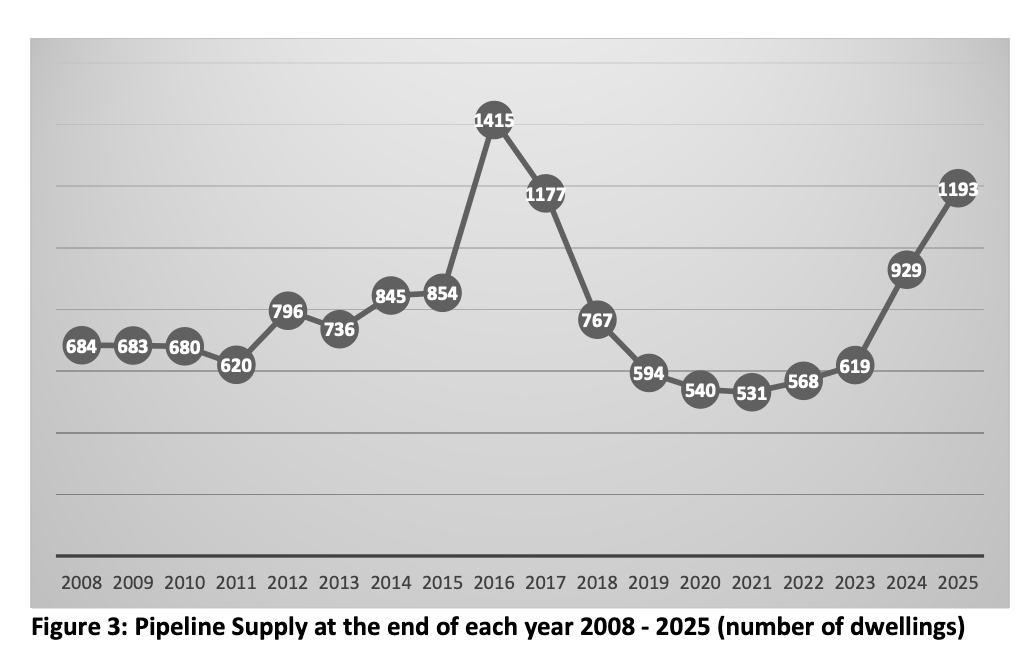
The latest monitoring report shows that the total housing pipeline (planning permission granted or under construction) reached its highest level of the year at 1,193 dwellings.
This was driven by a substantial volume of approvals in the final quarter when full planning permission was granted for 113 additional dwellings.
The annual net total of dwellings permitted in 2025 (excluding outline permissions) reached 356, significantly higher than the totals for 2023 (256) and 2024 (236).
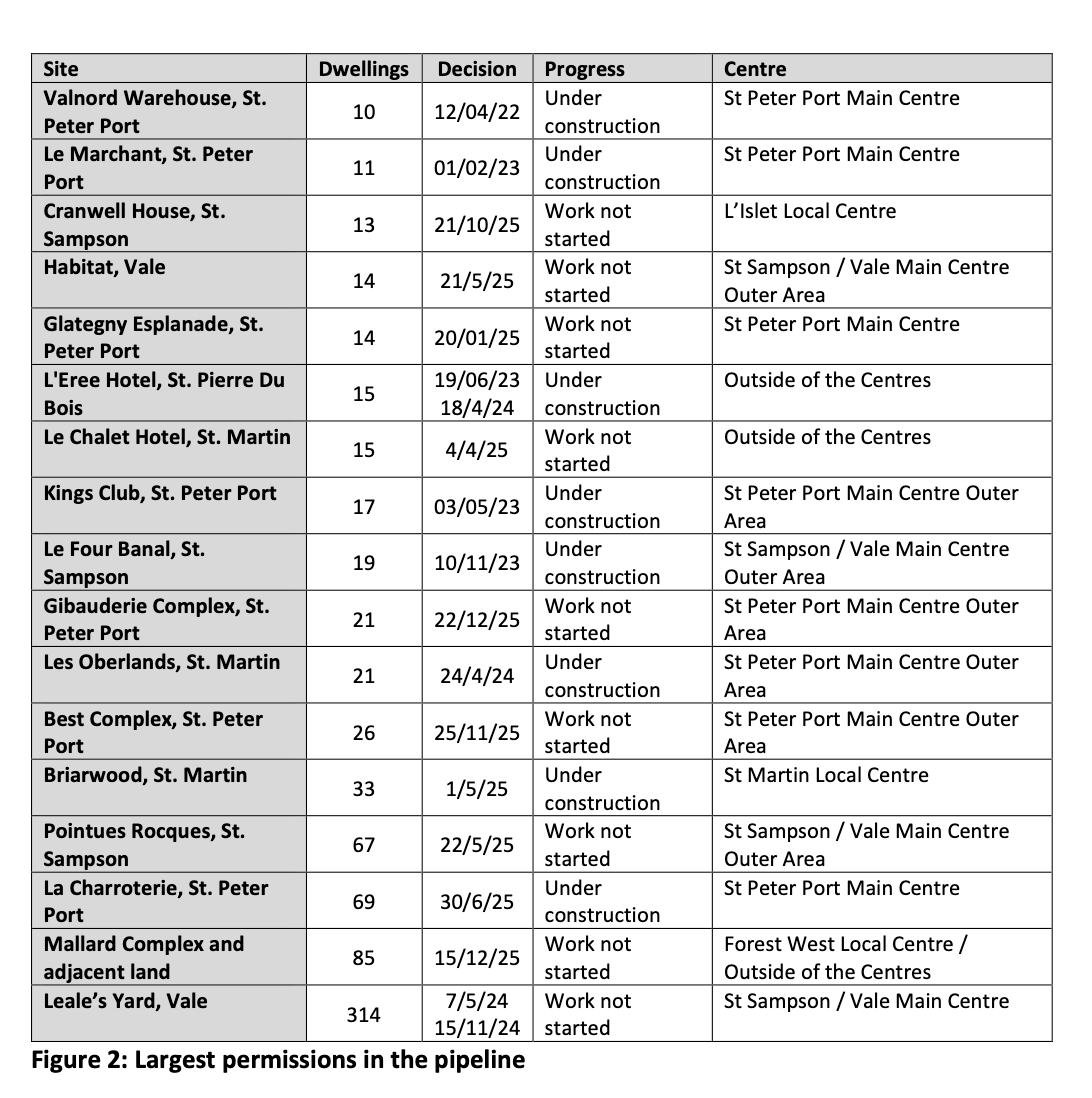
But while permissions are in pace, the picture when matched up to the States’ agreed ambitions shows that physical construction and the delivery of completed units continues to lag significantly behind what is needed.
The revised SSHI, approved in December 2024, requires the creation of 268 to 327 new dwellings per year between 2024 and 2028.
In 2024, only 72 dwellings were completed, so to reach even the lower end, the island would need to nearly quadruple its 2024 completion rate.
At the end of Q4 2025, there were 355 dwellings under construction. Residential projects typically take longer than a year to complete, and this is near the 10 year average of 321 units being built, rather than surging to meet the annual completion requirement as is needed.
Past trends also suggest that a significant proportion of the pipeline never actually turn into houses.
Of the 109 full planning permissions granted in 2022 (representing 247 dwellings), 40 dwellings had already lapsed by the end of 2025 because building work never started.
While the pipeline for affordable housing grew from 72 units in the first quarter to 153 in the final one, primarily because of outline planning permission for 69 units at the Mallard complex, this remains below the minimum required 2-year supply of 243–296 units.
Planning considering fast tracking larger projects and how homeowners can build to accommodate family
Development and Planning Authority President Neil Inder said that active engagement was already reaping rewards and there was more to come.
“We are considering fast-tracking some of the larger sites, and the digital programme remains on track to be delivered by the middle of the year.
“In other news — and something Guernsey residents will be pleased to hear — the Authority is developing plans around the concept of multi-generational living. This will look at what can be permitted for homeowners who wish to care for older relatives or accommodate returning family members. A solution will be announced in due course.”
He reiterated that the market was driven by confidence.
“Build confidence in policy and in people, and you are on the path to delivery. These are exciting times, and I would like to thank investors, developers, and the wider island community for helping to keep the economy moving.”
Housing Committee President Sasha Kazantseva-Miller said that it had been great to see the uptick in the number of houses being built, one of its key objectives.
“While there will be many factors that are leading to this, the Committee has been focused on site-specific work, including engagement with individual key landowners and developers to understand why sites that can provide ten or more homes are not progressing and what government might be able to do to unlock these sites for much needed housing.
“This engagement has been well received and has enabled some sites to move forward. Toward the
end of last year, we expanded this to focus on sites that can accommodate between five and ten homes to understand what is stopping development from coming forward.
“It’s really promising to see this progress and we look forward to continuing to work together with the industry to deliver more homes for Guernsey.”
Other trends in Q4
Smaller office units in the hearts of St Peter Port and St Sampson are being phased out in favor of residential use.
The trend continued strongly in the last quarter of the year.
There was a net total loss of 911m² of office floorspace permitted this quarter (1,362m² in Q1, 362m² in Q2, 98m² in Q3).
Of the 12 permissions involving a change in floorspace in the final quarter, five were from offices to residential in the Main Centres.
By the end of 2025, the cumulative net change in office floorspace approved since 2023 (excluding the specific Office Expansion Area at Admiral Park) reached a total loss of 6,855m².
The Island Development Plan generally seeks to retain offices in Main Centres, but explicitly allows smaller premises to change use to address oversupply.
One driver is an exemption, which allows the upper floors of buildings in Main Centres currently used for offices or retail to be converted to residential use without full planning permission, provided the floorspace does not exceed 250m².



Comments ()