
Guernsey Ports and Trinity House complete replacement of critical navigational aid
- Guernsey Ports and Trinity House will replace the Reffée Buoy, a critical South Cardinal navigational aid marking rocks north-east of QE2 marina
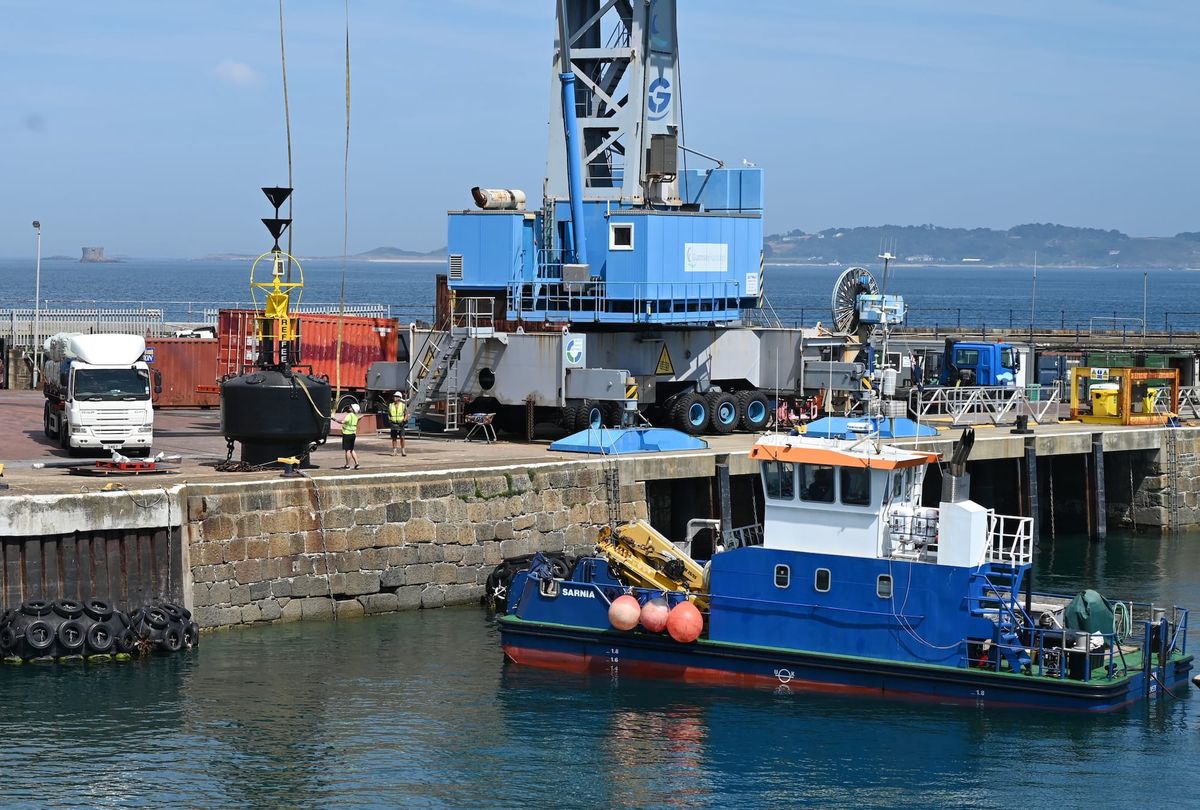
- The operation involves Guernsey Ports' Sarnia workboat and Trinity House's buoy-handling vessel THV Galatea
- Cardinal buoys are replaced every three years as part of a rolling maintenance programme due to wear from tidal currents, wave action and weather
- The removed buoy will be inspected, grit blasted, repainted and reconfigured to become the Lower Heads buoy next year
- Guernsey Ports maintains around 60 aids to navigation in local waters as the Local Lighthouse Authority
A specialist offshore operation to replace one of the Bailiwick's most important navigational aids is being completed by Guernsey Ports and Trinity House this weekend.
Guernsey Ports' Sarnia workboat and Trinity House's buoy-handling vessel THV Galatea will remove and replace the Reffée Buoy, a South Cardinal Buoy which marks the southern limits of a group of rocks to the north-east of the QE2 marina.
The Reffée Buoy is one of three major cardinal buoys maintained by Guernsey Ports in local waters, alongside Lower Heads and Fourquies. The buoys are replaced on station as part of a rolling maintenance programme, with a fourth buoy kept ashore in preparation for the next deployment.
James Way, Harbour Master, said: "Maintaining these navigational aids is a year-round responsibility for Guernsey Ports as the Local Lighthouse Authority for the Island. A significant amount of work takes place behind the scenes before a buoy ever reaches the water."
"Our teams carry out the refurbishment, preparation and ongoing maintenance of this infrastructure. The specialist capabilities on board the Galatea, including its heavy-lift deck crane and dynamic positioning system, enable us to safely complete the offshore exchange."
Mr Way added: "The buoy being brought ashore will now be inspected, grit blasted, repainted and reconfigured with the appropriate top marks to become the Lower Heads buoy next year."
Each buoy is typically removed from service every three years to allow for a full inspection and refurbishment of the buoy structure and the heavy-duty mooring chains that secure it to the seabed.
The cardinal buoys require replacement every three years because they are exposed to powerful tidal currents, wave action and changing weather conditions. The mooring chain allows the buoy to rise and fall with the tide and absorb the constant forces acting upon it, while remaining securely attached to a massive concrete sinker on the seabed. Over time, that movement causes wear on both the chain and the buoy, making regular replacement and refurbishment essential.
Because of the size and weight of the cardinal buoys, specialist lifting equipment is required to carry out the exchange at sea. Guernsey Ports works closely with Trinity House as General Lighthouse Authority for Guernsey, using one of their dedicated buoy-handling tenders to undertake the operation safely and cost-effectively.
As a South Cardinal Buoy, the Reffée Buoy's downward-pointing arrows signify that safe water lies to the south of the buoy.
As the Local Lighthouse Authority, Guernsey Ports maintains around 60 aids to navigation in local waters, including buoys, beacons and harbour traffic signals, which undergo regular inspection and refurbishment to ensure they continue to operate safely and reliably.
Trinity House, as the General Lighthouse Authority, is responsible for those navigational aids that are used for general navigation in the region. These aids are Les Hanois Lighthouse, Casquettes Lighthouse, Point Robert Lighthouse on Sark, Alderney Lighthouse and Blanchard Buoy.
Q&A
Q: Why do the cardinal buoys need to be replaced every three years?
A: The buoys are exposed to powerful tidal currents, wave action and changing weather conditions. The mooring chain allows the buoy to rise and fall with the tide and absorb constant forces whilst attached to a concrete sinker on the seabed. Over time, this movement causes wear on both the chain and the buoy, making regular replacement and refurbishment essential.
Q: What does the Reffée Buoy mark?
A: The Reffée Buoy is a South Cardinal Buoy which marks the southern limits of a group of rocks to the north-east of the QE2 marina. Its downward-pointing arrows signify that safe water lies to the south of the buoy.
Q: How many navigational aids does Guernsey Ports maintain?
A: As the Local Lighthouse Authority, Guernsey Ports maintains around 60 aids to navigation in local waters, including buoys, beacons and harbour traffic signals. The three major cardinal buoys are Reffée, Lower Heads and Fourquies, with a fourth buoy kept ashore for the next deployment.

Comments ()