
Dig This: unlocking housing development in Guernsey
- Only 62 housing units were added to Guernsey's housing stock last year, far short of the aprox 300 annual target, with none in the affordable sector
- Government initiative has seen 22 meetings covering 17 stalled development sites to understand barriers preventing housing construction
- Obstacles include expensive contaminated land disposal costs from old greenhouse sites
- Solutions being implemented include streamlined planning processes, housing site progress monitoring and potential incentives or penalties for developers
- 355 homes are currently under construction, with major projects like 70 apartments at former CI Tyres site and 85 units at the Mallard soon to move forward
The figures do not lie.
Last year just 62 units were added to the housing stock, none of them in the affordable sector.
The current overall target is around 300 houses a year.
They are stark numbers and Guernsey has rarely been anywhere close.
This is not for the lack of permissions being in place. If everything that was given the green light by planners went ahead, the island would not have the type of housing dilemma which is slowly strangling society and the economy.
You can dive into any number of high level reports for the big picture, but work instigated 18 months ago under Environment & Infrastructure and now being taken forward by the Housing Committee has gone into the reality of what is happening on the ground.
What is preventing larger sites of five or more houses coming off the drawing board to become spades in the ground and then houses?
Some of them were allocated for housing but did not come forward, some have a development framework to guide what should happen, some planning permission, some building had already begun but stalled. What they all had in common was they were not being completed.
“The [E&I] committee thought it was really important to get to those landowners and have a conversation to find out exactly what was the issue,” said Infrastructure & Environment Director Claire Barrett.
“Because all the figures in terms of the pipeline supply of land for housing indicated there should be enough land available, but sites weren't coming forward.
Just why is that?
“There was one round of those meetings, then we had the change in government, and the Housing Committee took over the mandate for that. It was very, very well received by the developers and landowners.
“I think just the chance to get around the table and positively speak to officers and politicians about what the issues are was really, really well received by the industry as a whole, and the landowners, and some sites had multiple meetings on them.”
Sometimes the block was simply a misunderstanding of the information.
Others sites were no longer viable for housing, so discussion could move to different types of development instead.
Several themes also emerged.
“In all, there's been 22 meetings which cover about 17 sites that have come forward. But most productively, it's identified a number of issues. Whatever government can do to de-risk those sites and potentially make them viable to bring forward is what we really want to look at.”
Contamination costs
One of the issues that was highlighted was to do with the cost of disposing of contaminated land.
“A lot of the allocated housing sites have elements of redundant vinery sites on them, and there's a particular issue in Guernsey with lead contamination from old greenhouse sites, so with lead paint, as well as pipes, etc.
“Because of that it's actually getting very expensive to dispose of the land, effectively, the whole site has to be stripped and then it has to be disposed of. That was added significantly to building costs and can be just enough to tip it into not being viable to go ahead, combined with other risks.”
Last summer, the team worked with Guernsey Waste to clarify and amend the waste acceptance criteria which means that very low levels of contamination can go to the normal inert waste site. That's reduced the cost for some forms of contamination.
“We're working with Tobin Cook and the team at Environmental Health to look at a land contamination regime for Guernsey under the pollution control regulations that will involve legislation.
"So that's not a quick fix, but… if it results in a register of contaminated land, it will mean that there might be cases where you can just identify the land of certain contamination and leave it on the site and design it into the development and the parking, for example, that kind of thing.”
Housing Committee President Steve Williams said that at the moment if you look at a brownfield ex-vinery site and a greenfield site, the developer is going to go with the greenfield because it was lower risk and less cost.
“We'd really try to balance that out a bit and make brownfield more attractive than it is now to develop.”
Addressing the open market and planning
Action has also been taken on the open market register that has made it easier for developers to transfer inscriptions onto new development sites.
That can help make it viable to also build local market properties on that site.
Legislation has also made it easier within the open market to downsize, which means that potentially larger properties shift back onto the local market.
“There was a lot of discussion, I think probably in every single meeting I had, about planning and the process that there is at the moment for pre-application discussions, and then through the planning process, which tends to be the same for every type of development, whether it's a dormer window or 50 houses,” said Barrett.
The Development & Planning Authority are looking at a form of planning performance agreement, so that certain types of development go through a different process, which means it can be front loaded, so some of the conditions that you would normally find right at the end can be done at the beginning, and all interested parties meet round the table at the start.
That could be government, the developer, the landowner, traffic, for example.
“Everyone's trying to do the same thing, which is produce the right type of housing in the right places,and actually working more as a development group to produce that, rather than keep hitting up against hurdles all the way through.”
New visibility on what is happening
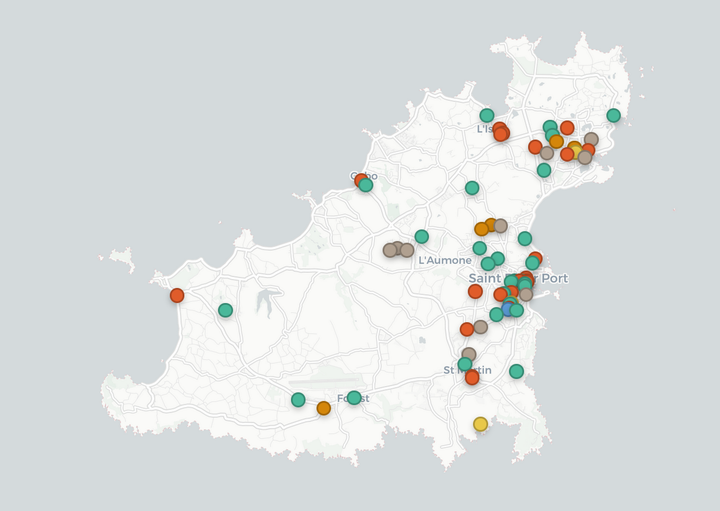
Housing’s freshly released housing site availability framework is another tool to shed more light on what is happening.
It lists all the sites where housing should be coming forward and what stage of the process they are at and is the basis for The Quarry's tracking site above.
“It gives everyone a flavor of what's there,” said Deputy Williams.
“It also gives the people who supply the industry, whether that be with materials or labour, an idea about what the potential workload is, what's coming forward.
"We want to refine it more with timescales, so that I think there's going to be another version coming out in due course. We've just got to overcome one or two issues in terms of trying to make sure we don't breach any confidentialities on that.”
Just raising the profile of these sites can help, he said.
“We want to keep it alive, ideally, update it every six months with fresh information, and we want the industry to feed back to us in terms of, ‘okay, this isn't going to happen, this is going to happen’, or flag up to us if, additionally, where there are problems, and is there something we could do to assist.
"We want to assist where we can, to facilitate those sites and bring them forward, because the more private housing, the better.”
The feedback from industry on the work to date had been positive, he said.
“The communication has been very open, and that's helpful and generally, people just like to be listened to and then see something happening. And that's what we've been keen to do.”
Incentives and penalties
Housing has been assessing viability matters and what levers it could pull.
It may start to look at grants or loan guarantees as incentives.
“But obviously they involve money, and times are tight, and we've got to be very careful that we're targeting funds where it's really needed.”
On the other side are penalties like raising TRP dramatically on derelict land
“Those are things that we're undoubtedly going to be looking at. We'd prefer to do the incentives than hit people. But if we're trying to talk to people, and they're just not interested, and they're just going to sit on stuff and land bank it for whatever reason then that's no good for the island, then we need to, if they won't go for the incentives, we'll need to work on the penalties.”
Compulsory purchase is another area that is rarely used in Guernsey, but is another part of the armory.
“There's always upsides and downsides to these things, and there are potential consequences that we need to weigh up. So I don't think it's entirely simple and cut and dried, but I think it's something that we need to keep in our back pocket and potentially use if people aren't coming forward positively.”
Rental prices remain another area of concern.
“We are looking at that, and we are working on some responsibilities on landlords and tenants. We're considering what Jersey has done in terms of trying to look at some sort of controlling rents again, there's upsides and downsides of that, and we don't want to be losing landlords from the market either. So we have to be very careful to try and balance this.”
Deputy Williams does not see the States becoming a housing developer again, but it will work more in partnership with developers.
“I think for us to gear up to the point where we are a contractor ourselves, is just going to take too much time and effort. We don't have a team there ready to just shoe horn in and start doing that.
“There are developers and contractors with those skills already, so I see us more likely to say, ‘Okay, we have some funds here. We're in the market to, as it were, buy completed homes’. And it may be that we're putting in land, or it may be that we're giving monthly payments, so we ease people's cash flows. The contractors and developers involved have got pre-sales, so that helps their bank finance.
"So we can help in the process with those sites to bring them forward faster, and then there'll be a mix of ownership in terms of they'll be rented, there'll be first time buyer, and there'll be outright sale homes. So I see us getting involved in those sorts of arrangements, like a joint venture or partnership arrangement.”
Action on multiple fronts - importing labour, modular options and rethinking how land is allocated
There is no magic wand, said Deputy Williams, but they were working on a lot of different fronts.
“It takes a long time to build a home, and people will be aware of that when they look around the island. If you do it in the traditional way, block work, which everybody loves, it's solid, it lasts forever, then it takes, it takes a good while.
“We're also onto the issues about building capacity in the island, in terms of labor that has shrunk since the pandemic. It's more difficult bringing it in since Brexit. And so we do have challenges there. There's an aim to try to grow that capacity, but that's not an overnight issue.
“I think we'll end up with potentially people having to come into the island on short term contracts just to supplement the capacity in the island.
“To supplement that, we have been talking within the States about modular housing, but there again, it only works in certain sites. How long is it going to last for? You've got to look at the value for money, in terms of the longevity and also where it goes. You're still having to put all the drainage in, the power, some road system, and all the rest of it. So that's not simple. It needs to be in a location where, ideally, it's going to stay there for 15/20 years to get some value out of it. And might you want to be building those out traditionally rather than with modular?
“It's being looked at in terms of the practicalities of it, but it's not necessarily the easy, quick fix that some people might consider, because there are always ramifications to these things.
“Some people say, ‘Oh, I quite like what you're doing, because it's not seismic in terms of throwing a great bomb into the housing market, you're working a lot of fronts on the basis that a few of those get going, and a lot of actions then create a decent whole, and that you help them market without basically upsetting the market.’
"I think that's what you have to watch in a small market. These things all have consequences, really. So we're working on a lot of fronts.”
Another of the conversations going forward is about how sites are allocated for housing.
Traditionally that has been essentially spatial, about where it sits in the island, rather than taking into account the financial reality of a project.
Now the thought is that sites should come forward with a business case before the land is allocated for housing that shows how it will be financed and over what timeframe you will develop it.
If you do not meet those parameters, then that allocation is taken away from you. The idea is to flush out who is serious about developing their land as opposed to those that are effectively just banking it because of the uplift in the value.
It comes back to moving beyond just looking at the number of permissions in the development pipeline.
“From a planning officer's point of view, you think, ‘Okay, I've ticked the box. I've done my numbers’, but actually, are they going to be converted into completed homes? Well, some slip by the wayside and never happen.”
There are 355 homes under construction at the moment.
These will flow through over the next two years, which should be a lot more positive than the 2025 figure which given the timescale for construction reflects the slowdown on building caused by Covid lockdowns.
From an affordable housing perspective, the Guernsey Housing Association is close to tying up a contract to build on the former CI Tyres site which will provide 70 apartments.
Groundworks are expected to behind this summer at the Mallard, which has a mix of 69 affordable and 16 private units
But the sums remain simple.
None of this is currently enough.
Q&A
Q: How many housing units were added to Guernsey's housing stock last year?
A: Only 62 units were added last year, with none of them in the affordable sector. This is far short of the current target of around 300 houses per year.
Q: What is the main issue with contaminated land disposal in Guernsey?
A: Many allocated housing sites have redundant vinery sites with lead contamination from old greenhouse sites, including lead paint and pipes. The entire site must be stripped and disposed of, significantly adding to building costs and potentially making developments unviable.
Q: How many homes are currently under construction in Guernsey?
A: There are 355 homes currently under construction, which will be completed over the next two years. This should provide a more positive outlook compared to the low 2025 figures that reflect the COVID lockdown construction slowdown.
Comments ()