
Dig This People & Skills Special: How AI is beginning to transform Guernsey’s workplace
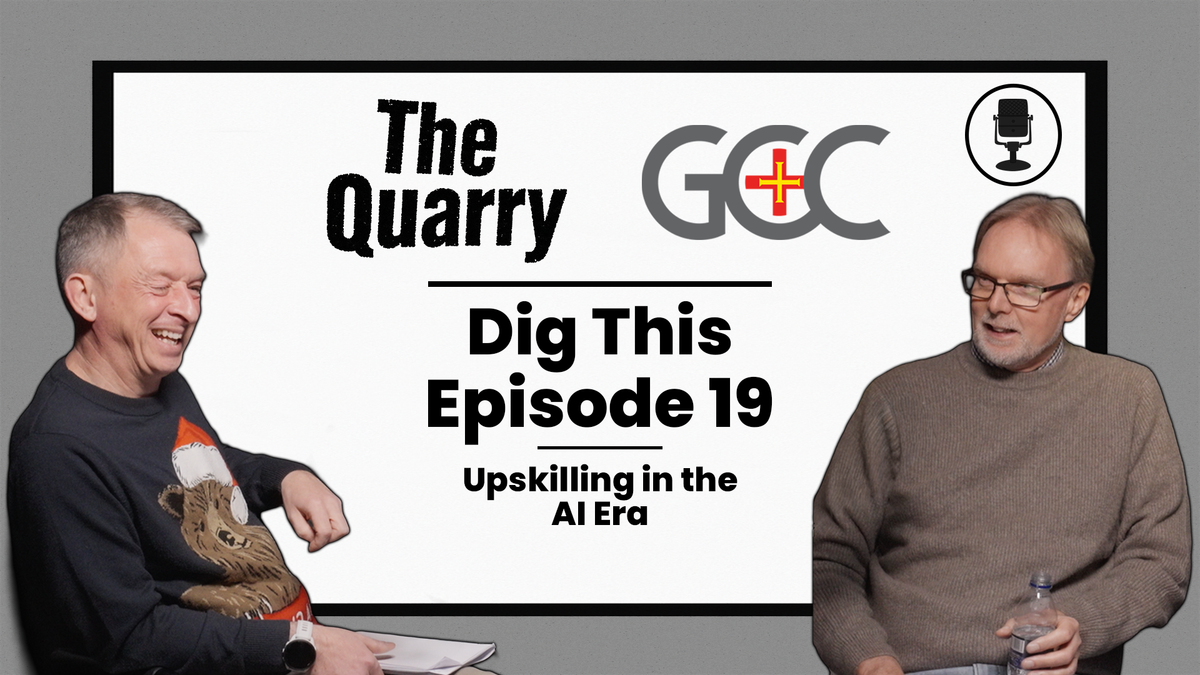
In episode 19 of the Quarry Podcast, host Nick Mann is joined by GTA CEO Simon Le Tocq and Tech Entrepreneur Ian Campbell, to explore the burgeoning role of AI in Guernsey.
The discussion, which featured a real-time AI assistant named Emma, painted a picture of an island at the outset of a significant technological shift, one that could act as a liberator for the local workforce and a catalyst for stalled economic growth.
From experimentation to strategy
While AI technology like Siri and Amazon Alexa has been part of the community for years, the true turning point arrived in 2023 with the release of OpenAI’s GPT-3.
Since then, people have transitioned from "playing" with the technology - using it to write poetry for example - to treating it as a core component of their corporate strategy.
According to Le Tocq, the island is currently in the early stages of a journey that begins with generative AI tools like ChatGPT and Microsoft Copilot but is rapidly moving toward more sophisticated systems.
Campbell noted that in 2024, many attending courses were merely curious about implementation, but by 2025, a significant portion of organisations had already developed formal AI strategies. This shift reflects a growing recognition that AI is not a fleeting trend but a transformative tech cycle comparable to the PC revolution of the 1980s, though with far greater implications.
The productivity "power tool"
A central theme of the discussion was the potential for AI to solve Guernsey’s long-standing productivity issues.
For a decade, the island’s economy has largely "flat-lined," and businesses often struggle to expand due to a lack of human resources. AI is being viewed as a new type of resource—a "machine workforce" that can unload the administrative burden from human employees.
Emma the AI described the technology as a "great equalizer," providing workers with a "power tool" that allows them to perform at higher skill levels.
By automating routine admin tasks—such as scheduling, email sorting, and document compliance checks—AI frees up "thinking time".
Campbell said that for business leaders, this means reclaiming mental capacity previously lost to quarterly reports and annual reviews, allowing them to focus instead on high-level strategy and moving their companies forward.
The rise of agentic AI
The experts emphasised that the next phase of evolution is agentic AI.
Unlike current generative systems that simply respond to prompts, agentic systems can independently carry out complex tasks.
Emma provided several local scenarios for this technology:
• Finance: Automating adverse media checks for thousands of clients, acting as a digital copilot for compliance teams.
• Tourism: Creating bespoke, personalised itineraries for visitors to discover local gems.
• Public Services: Streamlining planning applications and administrative inquiries.
This evolution is fueled by a massive global investment in hardware and data centers. Campbell noted that Nvidia’s latest GPU modules offer computing power equivalent to some of the world’s largest data centers, a development that will likely trigger an incremental change in AI capabilities by late 2026.
The shadow AI risk and the need for policy
Despite the optimism, the transition presents significant challenges, particularly regarding data privacy and security.
Campbell warned of the shadow AI phenomenon, where employees use personal devices to upload sensitive company data into insecure, non-GDPR-compliant systems. Some tools, such as the Chinese model DeepSeek, explicitly state in their terms and conditions that they will take user information.
To combat this, the experts urged businesses to implement clear AI policies.
"You don't want them to be using insecure AI systems," Campbell stated, emphasising that the first step for any firm should be providing a "safe" corporate AI environment that is locked down and properly trained.
Upskilling the Guernsey workforce
The GTA has seen a rise in demand for hands-on training, with courses ranging from three-hour introductory sessions to specialized boardroom briefings for directors.
The goal is AI literacy—demystifying the "scary black box" so that employees at all levels feel confident using these tools.
Key skills for the modern workforce will include:
• Adaptability: The willingness to learn as the technology evolves.
• Soft Skills: Critical thinking, ethical reasoning, and complex problem-solving, traits that machines cannot easily replicate.
• Prompt Engineering: Learning how to effectively communicate with AI to achieve specific results.
Le Tocq noted that AI also allows for the personalisation of learning, enabling individuals to receive "just-in-time" training on specific tasks, such as calculating net present value or learning a language, without waiting months for a traditional course.
Government and social responsibility
As AI begins to replace certain cognitive tasks, the conversation turned to the socio-economic impact on Guernsey’s 24,000-strong workforce.
While some fear job losses, the experts pointed to history, noting that technology typically increases net productivity and creates new types of work.
Guernsey has navigated such transitions before—moving from a tomato-growing economy to a global finance hub, though the pace of the AI revolution will be significantly faster.
The speakers suggested that the States must play a lead role in this transition. While some civil servants are currently trialing tools like ChatGPT, a macro-level strategy will be essential by 2026 to coordinate retraining programs and set ethical frameworks.
AI could even assist politicians directly by summarising complex technical reports, such as the island's electricity strategy, into understandable layman's terms.
Recommendations for local businesses
The experts' advice for those feeling overwhelmed is to "start small".
Organisations should identify specific "pain points"—such as HR handbooks or customer service responses—and apply AI to those areas first.
Building confidence through simple applications will prepare firms for the more robust systems expected to arrive in the coming years.
As Le Tocq concluded, the most important thing is to get in front of the technology: "Work is learning and learning is work... if you're not constantly upskilling, then you're falling behind".
This overview was compiled with the heap of NotebookLM.



Comments ()