
As the world fractures, some see defense as both an investment opportunity and a way to keep us safe

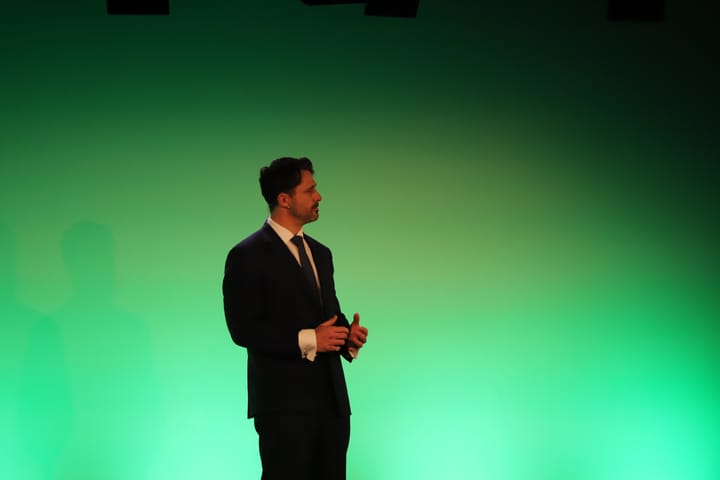
Private sector investment is needed to bridge a huge funding gap in the UK’s defence spending which creates an opportunity for Guernsey’s finance industry, it was told by General Sir Richard Barrons.
Sir Richard co-authored last year’s Strategic Defence Review in the UK, and has urged everyone to think differently about their security.
He argued that we were living in a new era that people were not ready for which made them vulnerable.
“We need to acknowledge that in this difficult world, it's a global competition, and there are big prizes for those that innovate their way through this, and great disasters for those that exist in a world of denial or or proceed with great caution,” he said while addressing the Guernsey Finance Industry Update.
“And essentially, I'm confronting you with a choice: you can simply reject what I'm telling you and run on hope and denial, or you can make better, more difficult choices and seize opportunity and avoid risk.”
Since the Cold War ended in 1989, generations have lived without having to worry about the risk of war, he said.
“Yes, we dealt with terrorism and worried a bit about a cyber attack, and you might have had natural and man made disasters, but we were free from existential risk, and that has bred the habits that infuse how you think about the world today,” he said.
“But now we live in a different world, a much more uncertain, demanding, challenging and dangerous world, defined as state confrontation and potentially conflict.”
What was new was how this combined with a tableau of uncertainties about population growth, climate change, the proliferation of nuclear weapons and the transformation coming with digital.
Other things also made this era different, including the rolling back of US contribution to European security which had amounted to about $400bn a year, he said.
“That's not going to happen any longer. That's become pretty clear. We're only having a discussion about whether this is a cliff edge or a managed exit.”
He struck a frustrated tone over conversations about the cost of deterrence being balanced out against domestic spending on doctors, schools and potholes.
“If deterrence fails, and just look at Ukraine, the cost of going to war is trending 50% of your GDP for as long as it takes, plus all the destruction, plus all the trauma, which generally spans three to four generations… so the deterrence premium is the bargain of the century, and let's acknowledge this.”
War was an aspect of the human condition, he said.
“There are no rules, there is no safety net, no guarantees that you're going to come out of it well. But pretty much you can guarantee this kind of death and destruction. Look at what's happening in Ukraine.
"So if deterrence fails, exactly the sort of thing you see happening around the world in places like Ukraine can happen here in military capability terms, or London or elsewhere.”
Often when people think about war, they associate it with being about territory.
But Sir Richard said it was always a battle of wills and in today’s world a country could be broken without putting a single boot on the ground through a combination of things like cyber and attacks on national infrastructure.
“Your phone tells me the truth about who you are, where you go, what you spend your money on, what you worry about, who your contacts are, everything. And then I can message you using artificial intelligence, I can tell you the truth or I can lie to you, but I can really upset you.”
He warned that the types of missiles and drones that fall on Kyiv nightly could fall here.
“The point is, it can choose you. It only requires one to decide that the dance has started.”
The UK and all European nations can only survive by investing in collective security, he said.
There were two aspects for finance to focus on.
“The first is, in this return to an era of war, a partnership with industry is profoundly important to deterrence, and, if you have to fight, success and endurance.
“And the key thing is, in the world that we live in now, military force must constantly evolve at the speed of innovation, which comes from the private sector that you invest in.
“So not only are you on the pitch, as it were, as a target, you're also on the pitch as a key player in how you provide the capability that sustains deterrence.
“And yes, in the world that we live in, there are fortunes to be made in doing that well. But please see this not just as a business opportunity, but as your contribution as financial experts to your security and that of your communities and your families.
“It's a partnership, and it's not just about innovation. It is also about the speed at which you can do this and the scale at which you can deliver, so there's a whole manufacturing piece that's attached to this.”
Anybody that relied on supply chains to import things like energy, food, goods and medicine was “on the pitch”, he said.
“You may think about how the sea keeps you safe, but I'm here to tell you it is utterly irrelevant and actually a vulnerability.
"So there isn't really an outcome here, where, even in lovely Guernsey, you could decide simply to pull up the drawbridge and sit it out, if the world wants to think that you're on the pitch, you're on the pitch.”
In today’s world, defense was a whole society endeavour, he said.
“The true power of any country is the private sector, and yes, that's money and, of course, innovation, but it's also culture and law and insurance and banking and entertainment and the Premier League and all of those things that make the UK powerful in the world.
“So what we're talking about to keep us all safe is a partnership between what the armed forces do, what governments do, and the power of the private sector.
“And to be frank, that partnership is going to be defined partly by good people like you deciding to make collectively good decisions. So that's voluntary or by regulation. And in some circumstances, coming down the road quite carefully, a matter of law, in order to keep everybody safe.”
The digital age has changed how we live and work and play.
“It would be mad, wouldn't it, to conjecture that it's not going to change how we confront and how we fight?
"And the fact is, all these technologies that you invest in, AI data and secure cloud, autonomy, robotics, nano science, bio science, quantum computing, access to space, in combination that is engineering in a process, not in an event, the most extraordinary change in how you do armed forces, how you think about them, build them, operate them, for 150 years.”
The clock and the technological benchmarks are essentially right now already owned by China, and a little bit moderated by the US, Sir Richard said.
“You don't get to choose what good looks like. You just have to be better than it, or at least, please, keep up.”
He urged investors to get behind “this massive opportunity”.
“Because you can apply the innovation that you have funded into the military space, not, frankly, just for the UK, but looking at a European market and a global market.
"One of the core thoughts that underpins the Strategic Defense Review when we talk about the new industrial partnership, is that we'll attach to the right innovation. And when we do that by design, from the outset, we will make things, products and services that others will want to buy.”
He illustrated how the Armed Forces could change through a “digital kill web”.
“Any form of sensor, satellite, radar, computer, it doesn't matter, airplane, ship, tank, mobile phone, any form of sensor existing in a network, connected to a database in secure cloud, which you're investing in, run by AI tools which you're investing in, which identifies what that data is, prioritizes it and allocate it to the most appropriate weapons system, whether it's missile, a ship, a tank or a tweet, it doesn't much matter.
“That's what a kill web is. In the case of Gaza, a drone sees something, it communicates it to a database. The AI does its thing, it allocates what it now knows as a priority first target to the most appropriate weapon system, and that weapon system fires.
"That takes seven seconds, and you can do it over and over and over again at the speed of technology. In Ukraine, it's two minutes. But where this digital kill web technology goes, is that by the 2040s the China kill web and the US kill web will see something anywhere in the world and be able to strike it anywhere in the world, from home, so from China at the speed of hypersonics, which means across the world in about 24 minutes.”
This means we are entering the era of lethal autonomous weapon systems, he said.
There was not enough public money, so there was a need to find ways of getting private capital into defense now.
“This is a multi billion proposition.”
The UK’s defense investment plan, which spells out a programme of money and activities, should have come out in September, but is now expected in March.
It had been delayed, Sir Richard said, because the government could not agree how much money it wanted to spend on defense.
“They cannot close that gap to the tune of £28bn. I reckon that gap is going to be closed in part by you putting your money into defense, and when you do that for a profit, that's got to be a good thing.”


Comments ()