
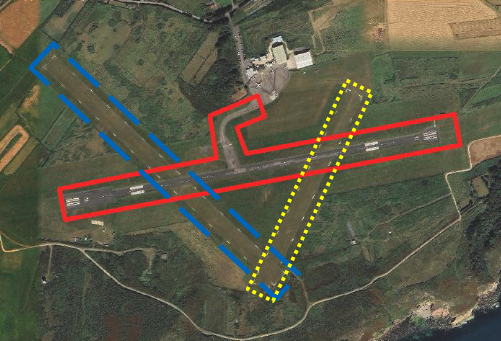
If the States had successfully followed through on a decision it made in January 2019, £12.2m. would have been spent on Alderney’s runway.
The runway would have been reconstructed at 877m, widened to 23m, new lighting and drainage installed, and the apron resurfaced, all the work done by mid-2021 based on research and consultants reports that stretch back to before December 2014 when the States first agreed the idea.
Instead, Policy & Resources is coming back to the Assembly in 2026 with proposals that mirror what was decided then, but counting the costs of indecision and changes that have essentially led all the way back to where the States was all those years ago, with a project now costed at up to £24m.
While we know the expected capital costs cap, we do not know what has been spent on consultant reports and staff time drafting up a myriad of options as States members here and in Alderney swung towards lengthening the runway and away again.
Policy & Resources is targeting work beginning on the runway in 2027 and will ask the States for delegated authority to approve the project with a £24m. cap.
“The approach we’re recommending aims to deliver a compliant, practical and proportionate solution within the current fiscal constraints,” said P&R president Lindsay de Sausmarez.
“Delegated authority to approve the business case and early contractor engagement will be key to the most timely and cost-effective delivery.
“We’re working to a tight timeline, with construction scheduled to start in April 2027 and complete by that December.
"This is lifeline infrastructure for the community in Alderney, and we’re committed to bringing it in as efficiently as we can, as well as at the lowest possible cost. That may mean some disruption for residents in Alderney during the construction process, but any delay risks pushing the project into 2028.”
A Timeline of Alderney Runway Proposals
January 2019: Option 3 (The restoration approach)
The States approved a plan to restore the existing pavements to provide a 20-year operational life.
• The Proposal: Reconstruct the 877m runway and widen it from 18m to 23m to improve crosswind safety. It included new LED lighting, centreline lighting, and improved drainage to protect the intersecting grass runways.
• Cost: Capped at £12.2 million.
• Why: At the time, an independent study by York Aviation concluded that extending the runway could not be justified because the market was too small for larger aircraft. The study warned that using larger planes prematurely would likely increase operating losses and reduce flight frequency.
• Key quote: In presenting the runway proposals in 2019, then STSB President Peter Ferbrache said it was a very easy decision: “Logic is on the side of Option 3; the facts are on the side of Option 3; the experts are on the side of Option 3; and the other interested parties are also both interested but objective and dispassionate … are also in favour of Option 3.”
November 2022: Option C+ (The expansion approach)
The States voted to replace the 2019 plan with a significantly larger project.
• The Proposal: Extend the runway to 1,050m, widen it to 30m, and build a new terminal and fire station.
• Cost: Estimated at £24.1 million.
• Why: The strategic driver shifted toward using the airport as an economic enabler. By allowing larger ATR 72-600 aircraft to land, Aurigny intended to simplify its fleet and potentially reduce the annual PSO subsidy by £800,000.
• Key quote: "This represents the best value for money for the Guernsey taxpayer." STSB vice-president Deputy Charles Parkinson.
April 2025: A pivot following tender failure
The expansion plan was abandoned when the procurement process returned a best and final offer of £37 million, nearly £13 million over budget.
• The Decision: The States resolved to pursue a "lowest possible cost and most practical and pragmatic approach".
• Why: The ballooning costs made Option C+ politically and financially non-viable within Guernsey's difficult fiscal situation.
• Key quote: “A significant part of the reason why we have not progressed with Alderney Airport this term has been over-ambition. It reached its apogee with the frankly ludicrous decision to put a 72-seater aircraft into an island of 2,000 people.” Deputy Yvonne Burford proposing a successful amendment to focus the investigation.
January 2026: The "do-minimum but compliant" design
The current proposal returns to a functional, utilitarian design.
• The Proposal: Reconstruct the runway at its existing 877m length but widened to 23m. It excludes the new terminal and fire station from the 2022 plan.
• Budget: Capped as a hard limit of £24 million.
• Why: In late 2025, Aurigny introduced Twin Otter aircraft for the Alderney route, which can operate on the existing length. The 23m width is the minimum required by regulators for a newly reconstructed runway of this specification.
• Key quote: “This is lifeline infrastructure for the community in Alderney, and we’re committed to bringing it in as efficiently as we can, as well as at the lowest possible cost.” P&R President Lindsay de Sausmarez.
Under the latest scheme it seems likely that the longer grass runway will close, while the shortest one will be kept as an alternative taxiway to access the main runway.
Neither of these runways are licensed for commercial aircraft.
Support from the key players
Alderney has backed the latest option.
Bill Abel, Chairman of the Policy & Finance Committee said: "The Policy & Finance Committee look forward to working closely with Guernsey's Policy & Resources Committee and the States Trading Supervisory Board to ensure best value is achieved and the project is delivered as soon as practicable.
“This engagement will also focus on minimising the impact of closures and evaluate viable options to minimise the risk of closure of the grass runways, taking into consideration overall benefits to the island."
The States’ Trading Supervisory Board, which has operational responsibility, also offered “strong support”.
The Alderney runway project was "essential renewal of a life-expired asset which underpins Alderney’s basic social and economic viability” its president Deputy Mark Helyer said in a letter of comment attached to the policy letter.
“This is a deliberately modest scheme which responds direct;y to the directions given by the States in April 2025 to deliver core connectivity at the lowest practicable cost, rather than to pursue any wider expansionary agenda.”
They were confident the project could be delivered within the £24m. Funding, which it said should be treated as a “hard cap, not a target”.
Five month closure anticipated to deliver runway work
Under the current timeline, the earliest that work could begin is spring/summer 2027.
When construction work takes place the airport will need to be closed for about five months. Plans will be drawn up to cover medivacs either by sea or helicopter and ensure ferry services are on offer.
Alternative options already tabled
Alderney’s Policy & Finance Committee submitted two alternative options for the rehabilitation work in July 2025 which they believed could have been done quicker than the latest proposals.
They were submitted by Associated Asphalt and Ronez.
“An initial technical review has demonstrated that the two proposals (Associated Asphalt and Ronez Ltd) both have merit and a clear commitment to finding a cost-effective solution,” P&R said in its policy letter.
“However, the review also identified several issues that require further consideration before these proposals could be adopted as a delivery route.”
This included the need for more detailed design work to meet regulatory compliance and insufficient evidence that they fully address underlying pavement structure and drainage issues.
“It may be that either or both firms could form part of discussions with the contractor engagement approach that is anticipated to begin in 2026, when the States of Guernsey can go to the market with a design.”
In July, while not naming the companies, Alderney published a press release titled "Alderney charts a practical path forward for Runway Rehabilitation".
Chair of the General Services Committee, Iain Macfarlane, said at the time: "Our goal from the outset was to demonstrate that viable, cost-effective, and deliverable solutions do exist — and we’ve done exactly that. We’ve drawn a line under the years of uncertainty and turned the conversation back to action."
Comments ()